


Pressure Points for Headache Relief a Practical Guide
When a headache hits, your first instinct might be to reach for a painkiller. But there's a powerful, drug-free alternative you can use anytime, anywhere: pressure points. This technique, known as acupressure, involves applying firm pressure to specific spots on your body to release muscle tension, boost blood flow, and kick-start your body's own pain-fighting systems.
It’s a surprisingly effective way to manage headache symptoms on the spot.
How Acupressure Works Its Magic on Headaches
For anyone wanting to sidestep medication, acupressure is a time-tested technique with roots in traditional medicine. The idea is simple but powerful: by stimulating key points, you can interrupt pain signals and help your body find its balance again.
When you press firmly on these 'acupoints,' you’re doing much more than just rubbing a sore spot. You’re actually setting off a cascade of positive physiological responses.
Untying the Knots and Getting Blood Flowing
So many headaches, especially those gnarly tension headaches, are born from tight, overworked muscles in the neck, shoulders, and upper back. Acupressure goes straight to the source, helping to relax those constricted muscle fibres.
This does two things: it eases the direct cause of the pain and improves blood circulation to the head and neck, which helps carry away pain-causing substances and deliver more oxygen. It’s like manually unknotting the problem. You can dive deeper into this connection in our guide on the science behind natural migraine relief.
This is a big deal in Australia, where headaches are a massive issue. Did you know that around 1 in 5 Australians get a headache at least once a week? And migraines alone affect roughly 4.9 million of us. With numbers like that, having effective, non-drug options like acupressure is a real game-changer. For more on this, check out the data on the impact of headaches in Australia on brisbanemigraine.com.au.
Tapping Into Your Body's Own Pain Relievers
Beyond just relaxing muscles, pressing on these points triggers the release of endorphins. These are your body’s built-in painkillers, often called the 'feel-good' hormones.
By activating these acupoints, you're essentially sending a memo to your brain to produce more endorphins. These then get to work blocking pain signals, creating a natural pain-relieving effect without any side effects.
This makes acupressure incredibly empowering. It puts you back in the driver's seat when a headache strikes, giving you a tangible way to find relief. It might not be a silver bullet for every headache, but knowing these points gives you a reliable tool to manage the pain and get back to your day.
Finding Key Pressure Points on Your Head and Face
When a headache hits, some of the most powerful pressure points for quick relief are right there on your head and face. The trick is knowing exactly where to press. Let's move past vague descriptions and pinpoint the precise landmarks you need, so you can apply pressure confidently and get real results.
These spots aren't random; they're usually found in slight hollows or over sensitive muscle tissue where tension loves to build up. A bit of firm, steady pressure can convince that tension to let go, easing the throbbing pain that comes with many headaches.
The Third Eye and Eyebrow Points
We'll start with a couple of the most famous points for headache relief, which are brilliant for tackling sinus pressure and those awful frontal headaches.
-
Yintang (Third Eye Point): You'll find this spot in the soft dip right between your eyebrows, where the bridge of your nose meets your forehead. It’s my first port of call for calming an overactive mind and easing that dull ache that settles in just behind the eyes.
-
Zan Zhu (Drilling Bamboo Points): This is a pair of points. Feel for the small indentations on the inner edge of each eyebrow, right where they meet the side of your nose. Pressing here feels fantastic when you're dealing with sinus headache pain or eye strain from too much screen time.
A great way to work these points is to close your eyes and use your index or middle finger. Apply gentle but firm pressure for about 30 to 60 seconds. As you press, concentrate on taking slow, deep breaths—it really amplifies the calming effect.
This visual guide breaks down how simple pressure can be turned into effective pain relief, releasing built-up tension and kicking your body's natural endorphin response into gear.
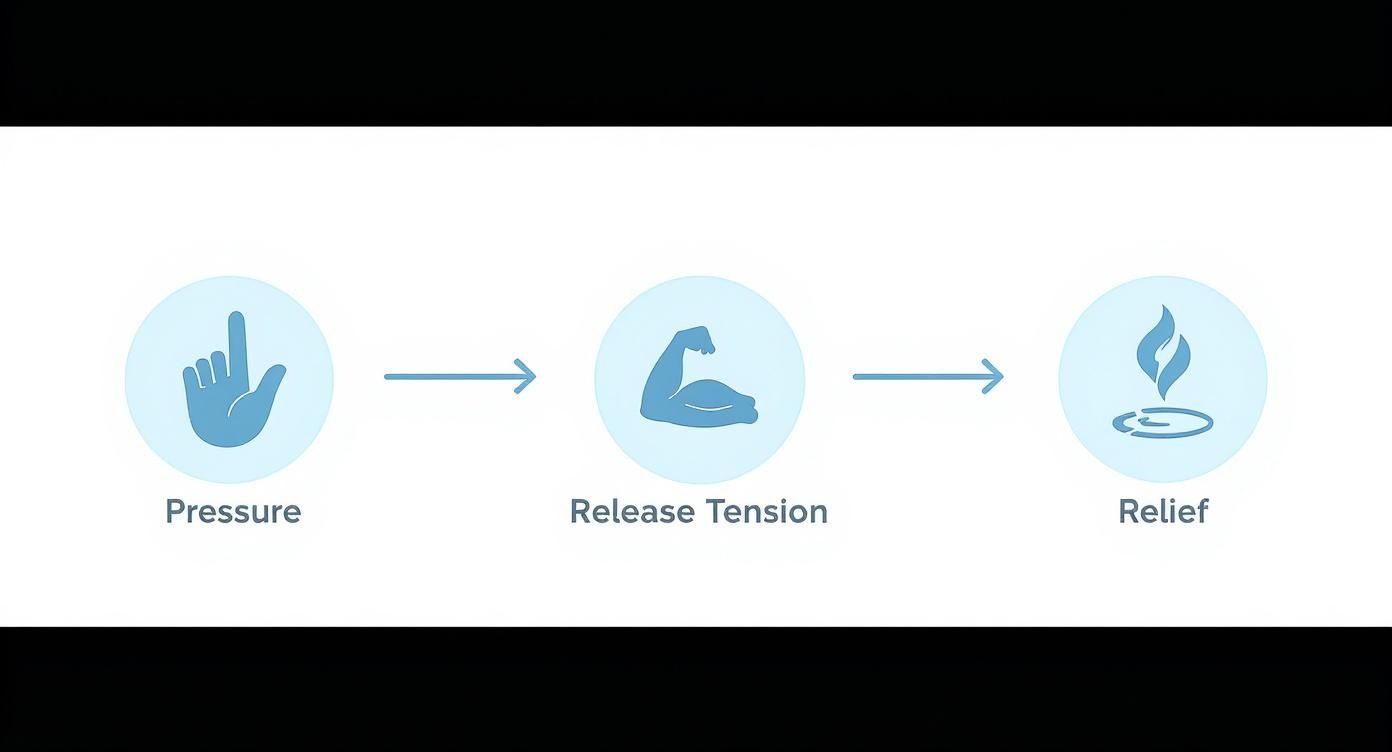
As the infographic shows, targeted pressure helps to release muscle knots and prompts your body to tap into its own pain-relieving systems.
Relieving Tension at Your Temples
For that classic throbbing pain at the sides of your head—the signature of a tension headache—the temple points are absolute game-changers.
The Taiyang points are located in the soft, often tender hollows on your temples. To find them, just move about one finger-width back from the outer corner of your eye. You’ll know you're in the right place when you feel a slight sensitivity under your fingertips.
To get the most out of these pressure points, place your index and middle fingers on both temples at the same time. Apply solid pressure and massage in slow, small circles. I find this gives almost instant relief from that awful vice-like grip of a tension headache.
This is a particularly handy technique when you're at your desk or stuck in a meeting and feel a headache starting to creep in. It’s subtle, quick, and can help you manage the pain before it gets worse. Just remember, you're aiming for a relieving, dull ache, not a sharp pain.
Using Pressure Points on Your Hands and Neck
When a headache starts to creep in, some of the most powerful and easy-to-reach pressure points aren't even on your head. By targeting specific spots on your hands and neck, you can often release the widespread tension that travels upwards and triggers that familiar pounding pain.
The best part? These points are discreet enough to use anywhere—at your desk, on the train, or right when you feel a headache coming on.
The most well-known of these is the Hegu (LI4) point, a real powerhouse for all sorts of pain relief. You’ll find it nestled in the fleshy, muscular bit of skin between your thumb and index finger. Go ahead and give that area a good squeeze; you’ll likely find a spot that’s a bit more tender or achy than the rest. That’s the spot you're looking for.

Using the thumb and index finger of your other hand, apply firm, steady pressure. Here’s a pro tip: aim the pressure slightly towards the bone of your index finger for the best results. Hold it for about a minute while taking a few deep, slow breaths, then repeat on the other hand.
Important Safety Note: The Hegu (LI4) point is known to induce contractions and should be strictly avoided during pregnancy. It is a powerful point, so it’s crucial to be mindful of this contraindication.
Targeting Neck and Shoulder Tension
So many of us spend our days hunched over screens, which means we carry a huge amount of tension in our necks and shoulders. This tightness is a major cause of headaches, particularly the kind that feels like a tight band squeezing your head. Understanding what a tension headache feels like can really help you zero in on the right pressure points.
Let's find the Jian Jing points, often called the "Shoulder Well".
- Picture a straight line from the big, bony bump at the base of your neck to the outer tip of your shoulder bone.
- The Jian Jing point sits right in the middle of that line, deep inside the large trapezius muscle. It usually feels like a tight, ropy knot.
You can reach across with your opposite hand and use your middle finger to apply firm, downward pressure. Try hooking your finger into the muscle and holding it steady, or making small, deep circles to encourage the knot to release. Working on both sides can feel like you’re physically letting go of the day's stress.
It’s no surprise that more and more people are turning to these non-drug approaches. In Australia alone, the economic toll of conditions like migraine is staggering, estimated to cost over AU$35.7 billion each year. This has pushed many to seek out alternative therapies that offer relief without a prescription.
Learning these simple pressure points on your hands and neck gives you a practical, hands-on toolkit you can use anytime. By getting to the root of muscle tension, you can often stop a headache before it takes hold or at least dial down its intensity significantly.
Mastering Your Acupressure Technique
Just knowing where the pressure points are is only half the battle. The real secret to getting proper headache relief lies in how you apply that pressure. It’s the difference between randomly pushing on a sore spot and intentionally signalling your body to release tension and pain.
Getting this part right is what turns acupressure from a hopeful guess into a reliable tool in your self-care kit. Let’s break down the hands-on skills you need to make every touch count.
Finding the Right Amount of Pressure
You’re aiming for pressure that’s deep enough to make a difference but not so intense that it hurts in a bad way. The sensation you’re looking for is often described as a “good hurt”—a noticeable, dull ache that feels therapeutic. If you feel any sharp, stabbing, or shooting pain, ease off immediately.
Think of it this way: you need to apply enough firm pressure to engage the muscle tissue under the skin, not just the surface. This focused approach is what really helps to break up those stubborn knots and interrupt the pain signals fuelling your headache.
Aim for a 7 out of 10 on your personal comfort scale. The pressure should be strong and purposeful, enough to grab your attention without making you wince. This is the sweet spot for activating the point without causing more irritation.
Applying the Correct Motion and Duration
Once you’ve found the spot and dialled in the pressure, how you work the point is the next step. You’ve got two main options, and which one you choose often comes down to what feels right for you and the specific point you're targeting.
-
Steady Pressure: This is as simple as it sounds. Just press and hold the point firmly without any movement. It's a great technique for calming points like Yintang (Third Eye) and can be done discreetly anywhere.
-
Circular Massage: Apply pressure while making small, slow circles with your fingertip. This method works wonders for releasing knotted muscles, especially around the Jian Jing (Shoulder Well) or Taiyang (Temple) points.
Whichever technique you use, try to hold the pressure for at least 30 seconds, and up to two minutes. The key here is consistency. This gives your nervous system enough time to get the message, release muscle tension, and kick-start the flow of those natural pain-relieving endorphins.
The Power of Mindful Breathing
Here’s a simple trick to seriously boost the effects of your acupressure: pair it with mindful breathing. It’s a small addition that makes a huge difference, sending a clear signal to your body that it’s time to relax and let go of stress.
As you press on a point, take a slow, deep breath in through your nose for a count of four, feeling your belly expand. Then, breathe out slowly through your mouth for a count of six. Simply focusing on your breath like this helps flip the switch in your body from a state of stress to one of calm.
This synergy creates a kind of mini-meditation that actively fights your headache on two fronts. The physical pressure tackles the tension, while your breath soothes the nervous system. Together, they create a much deeper and more lasting sense of relief, helping you manage the headache from the inside out.
Take Your Relief to the Next Level with Hot and Cold Therapy
While acupressure is a fantastic tool on its own, you can seriously amplify its benefits by bringing hot and cold therapy into the mix. Think of it as creating a powerful, one-two punch against headache pain. This combination tackles both muscle tension and inflammation, offering a much more complete sense of relief.
Essentially, you're using temperature to prep the area, making your acupressure work even more effective when you follow up.

Hot or Cold? Matching the Temperature to Your Headache
The real secret here is knowing when to use heat and when to reach for something cold. They work in completely different ways, but both aim for the same goal: to stop the pain.
A good rule of thumb I always follow is:
-
Cold Therapy for Migraines: For that intense, throbbing pain that comes with a migraine, cold is your best friend. A cold pack or a chilled Headache Cap helps constrict blood vessels and calm down inflammation, which are often the main culprits behind migraine agony. This process, called vasoconstriction, also has a welcome numbing effect. If you want to understand the science behind it, our guide on how cold therapy works for migraines is a great read.
-
Heat Therapy for Tension Headaches: When you’ve got a tension headache, it’s usually caused by tight, angry muscles in your neck, shoulders, and scalp. This is where warmth comes in. A warm compress or a gently heated cap is brilliant for relaxing those muscles, boosting blood flow, and easing that feeling of a tight band around your head.
The key takeaway is simple: use cold for throbbing pain and heat for tense, tight muscles. Just understanding this difference can make your at-home relief strategy so much more effective. It’s all about working smarter to manage your pain.
Choosing Between Hot and Cold Therapy
Here's a quick comparison table to help you decide which therapy is right for your specific headache symptoms at a glance.
| Therapy | How It Works | Best For This Headache | How to Apply It |
|---|---|---|---|
| Cold 🧊 | Constricts blood vessels (vasoconstriction), reduces inflammation, and numbs pain. | Migraines, sinus headaches, and cluster headaches. | Use a chilled Headache Cap, gel pack, or ice wrapped in a towel for 10-15 minutes on the forehead or temples. |
| Heat 🔥 | Relaxes tight muscles, increases blood flow (vasodilation), and soothes stiffness. | Tension headaches and headaches from neck strain. | Apply a warm compress, heat pack, or warm shower to the neck and shoulders for 10-15 minutes. |
This table simplifies the choice, but always listen to your body—sometimes what feels best is the right choice, regardless of the "rules."
A Practical Step-by-Step for Combined Relief
So, how do you actually put this all together? It's really straightforward. The idea is to use temperature first to prepare the area, then apply targeted pressure to get a deeper release.
Here’s a simple routine I recommend to my clients:
When a Migraine or Sinus Headache Strikes:
First things first, grab your cold pack or chilled Headache Cap. Place it over your forehead and temples—wherever the pain is most intense—and leave it on for about 10-15 minutes. This will help take the edge off that sharp, throbbing feeling.
Once the area is cooled and a little less sensitive, you can move on to acupressure. Gently but firmly press on the Taiyang (temple) and Yintang (Third Eye) points. Because the cold has already started to reduce the inflammation, the acupressure can work more effectively to release any lingering tension.
When It's a Nasty Tension Headache:
Start with heat. Drape a warm compress or a heat pack over the back of your neck and across your shoulders for 10-15 minutes. This is where most tension headaches start, so you want to get those big trapezius muscles to loosen up.
After the muscles have had a chance to warm up and relax, it’s time for acupressure. Use your fingers to apply deep, steady pressure to the Jian Jing (Shoulder Well) points. You’ll find the muscles are much more pliable and receptive, making it easier to work out those stubborn knots.
When Your Headache Needs Medical Attention
Using pressure points for headache relief can be a fantastic way to manage pain at home, but it's really important to know when a headache might be signalling something more serious. Think of acupressure as a helpful tool in your wellness kit, but never a replacement for professional medical advice, especially when certain red flags pop up. Your safety has to come first.
You should seek immediate medical attention if you ever experience what's often called a 'thunderclap' headache. This isn't your average pain; it's a sudden, excruciatingly severe headache that hits its peak within seconds and demands urgent evaluation.
Recognising Urgent Symptoms
Don't wait it out. Head straight to the hospital or call for emergency help if your headache comes with any of these symptoms:
- A high fever and a stiff neck
- Confusion, trouble speaking, or seizures
- Weakness or numbness down one side of your body
- Vision changes, like blurriness or seeing double
These could be signs of a serious underlying condition that needs to be diagnosed and treated right away.
When to See Your Doctor
Beyond those clear emergencies, it's also a good idea to book an appointment with your GP if you notice your headache patterns are changing. Are they getting more frequent? More severe? Or are they just not responding to the self-care techniques that usually work for you, like acupressure? These are all good reasons to get checked out.
In Australia, while pressure points and other complementary therapies are often used alongside conventional medicine, it’s worth remembering how significant headache disorders are. They lead to over 1.7 million GP visits every year and are a top-five cause of disability for Australians aged 15–49.
A surprising number of people never get a formal diagnosis, which is why it's so vital to chat with a doctor to make sure you're managing things properly. You can learn more about these findings from La Trobe University.
Common Questions About Acupressure for Headaches
It’s completely normal to have a few questions when you're first exploring acupressure. Let's walk through some of the things people often ask, so you can get started with confidence.
How Quickly Will I Feel a Difference?
This really depends on the headache. For a mild tension headache that's just starting to creep in, you might feel a wave of relief within just a few minutes of applying pressure. It can be surprisingly fast.
However, for more stubborn or chronic headaches, think of this as a consistent practice rather than a one-off fix. You may need to revisit the pressure points a few times throughout the day to really make a dent in the pain and keep it from returning.
Is Acupressure Safe? Are There Side Effects?
Acupressure is incredibly safe for most people. The biggest mistake is simply being overzealous and pressing too hard, which might leave you with a bit of soreness or even a small bruise. The key is to be firm, but always listen to your body—it should feel like a 'good' hurt, not a painful one.
The most critical thing to remember, as we touched on earlier, is that pregnant women must avoid the LI4/Hegu point on the hand. Stimulating this point is known to have the potential to induce contractions.
Is This a Treatment, or Can It Prevent Headaches Too?
It's actually both, which is what makes it so useful. When you feel a headache coming on, using these techniques is a fantastic way to treat the pain in the moment.
But you can also use it proactively. Regularly stimulating points like 'Jian Jing' on your shoulders can do wonders for releasing that built-up, day-to-day tension that so often triggers headaches in the first place. Over time, you might just find you're getting them less often.
For a drug-free way to enhance your relief with targeted hot or cold therapy, check out the Headache Cap at https://headachecap.com.au.


