


What Foods Trigger Migraines and How to Find Yours
It's a common question: what foods trigger migraines? While you often hear about culprits like aged cheese, processed meats, and red wine, there’s no universal "bad food" list that applies to everyone. The link between your diet and your migraines is deeply personal, driven by specific chemical compounds that can set off an attack for some people.
The Real Connection Between Food and Migraines

Figuring out your food triggers is less about vilifying one food and more about understanding your total "trigger load". A really helpful way to picture this is the ‘migraine bucket’ analogy.
Every day, different stressors fill this bucket. Think of things like:
- Poor or insufficient sleep
- Not drinking enough water
- Hormonal shifts
- Stress from work or home
- And, of course, certain foods
For many of us, a single slice of cheese or a glass of wine on its own might be perfectly fine. But what if your bucket is already close to full because of a terrible night's sleep and a stressful deadline? That one food could be the final drop that makes the bucket overflow, sparking a full-blown migraine.
It's More Than Just One Food
This 'bucket' idea is so powerful because it explains why a food might cause a migraine one day but not the next. It’s all about the combination of factors. Your diet then becomes a way to keep the overall level in your bucket low, rather than a frantic attempt to avoid every single potential trigger.
By making mindful food choices, you create more room in your bucket. This makes you more resilient to other triggers you can't control, like a looming storm or a demanding day at work.
An Australian Perspective on Food Triggers
Here in Australia, we know that food is a real factor for a significant number of people living with migraine. Studies suggest that around 10–20% of sufferers point to food or drink as a direct trigger.
This has led to highly structured methods for pinpointing personal triggers, like the well-regarded Royal Prince Alfred Hospital (RPAH) Elimination Diet.
Interestingly, Australian health experts often stress that one of the most common and potent dietary triggers isn't what you eat, but what you don't eat. Skipping meals or going too long without food can cause your blood sugar to drop, which is a major trigger for many. That's why the first piece of advice is often to eat regular meals and stay hydrated before you even start hunting for specific food culprits. You can find more great information on the Australian approach from Migraine & Headache Australia.
This guide will walk you through the connections between what you eat and how you feel. We'll dive into the specific compounds and foods that could be playing a role in your migraines, giving you the knowledge to start taking back control.
For a quick overview, here's a table of common compounds that can act as migraine triggers and the foods they're often found in.
Table: Common Migraine Trigger Compounds and Their Food Sources
| Trigger Compound | Common Food Sources |
|---|---|
| Tyramine | Aged cheeses (cheddar, blue, feta), cured or processed meats (salami, hot dogs), soy products (tofu, miso), pickled or fermented foods (sauerkraut, kimchi) |
| Nitrates/Nitrites | Processed meats (bacon, sausages, deli meats), some cured fish |
| MSG (Monosodium Glutamate) | Soy sauce, processed foods, fast food, some snack foods, Asian cuisine |
| Alcohol | Red wine, beer, champagne, dark liquors (whisky, bourbon) |
| Caffeine | Coffee, tea, energy drinks, chocolate, some soft drinks |
| Histamine | Fermented foods (yoghurt, kefir), aged cheeses, cured meats, spinach, avocado, tomatoes, alcoholic beverages (especially red wine) |
| Artificial Sweeteners | Aspartame and sucralose found in diet soft drinks, "sugar-free" lollies, and low-calorie packaged foods |
Remember, this is a starting point, not a definitive "do not eat" list. The key is to see if any of these line up with your own experiences.
Unpacking the Most Common Food Triggers

To really get a handle on food-related migraines, we need to look past simple lists of "good" and "bad" foods and dig into the why. It turns out, certain chemical compounds that are naturally present in many of our favourite foods are often the real culprits working behind the scenes.
Once you start to understand these substances, you'll become much savvier at reading labels and connecting the dots between your meals and a migraine attack. It’s all about spotting patterns you might have otherwise missed.
Let's break down some of the most common offenders.
The Tyramine Effect in Aged and Fermented Foods
Ever enjoyed a beautiful cheese platter only to be hit with a brutal migraine a few hours later? You may have tyramine to thank for that. Tyramine is an amino acid that forms when proteins in food break down over time, which is why you'll find it in high concentrations in foods that have been aged, fermented, cured, or even just left over for a while.
In people who are sensitive, tyramine can cause blood vessels to clamp down and then rapidly open up again. Think of it like a switch being flipped that sets off a chain reaction in your brain's vascular system, kicking off a migraine.
You’ll find high levels of tyramine in foods like:
- Aged Cheeses: Think cheddar, blue cheese, feta, parmesan, and Swiss.
- Cured and Processed Meats: Salami, pepperoni, bacon, and sausages are very common triggers.
- Fermented Foods: Things like sauerkraut, kimchi, pickles, and some soy products (miso, tofu) can be problematic.
- Certain Fruits: Overripe bananas and avocados can see their tyramine levels spike.
Nitrates and Nitrites in Processed Meats
Nitrates and nitrites are preservatives. Food manufacturers use them to keep processed meats looking fresh (maintaining their colour and flavour) and to stop harmful bacteria from growing. While they're useful for food safety, they can be a major migraine trigger for some.
These compounds are known to cause blood vessels to dilate, or widen, which increases blood flow to the brain. This sudden change is thought to be a key factor in triggering what's sometimes called a "hot dog headache," which can easily escalate into a full-blown migraine.
Nitrates and nitrites are hiding in plain sight in:
- Bacon and ham
- Hot dogs and sausages
- Deli meats and cold cuts
- Pepperoni and other cured meats
Australian headache organisations consistently highlight tyramine‑rich and nitrate-containing foods as common culprits. Guidance from local clinics often points to aged cheeses, cured meats like salami, and fermented products as potential triggers due to these compounds.
Histamine Overload from Fermented Foods and Drinks
Your body produces its own histamine, but we also get it from many foods. For most of us, a special enzyme in our gut quickly breaks down any histamine we consume. No problem.
But for some people, this enzyme doesn't work as well. This deficiency means histamine can build up in their system, and because it plays a role in inflammation and brain signalling, this overload can trigger a migraine.
Pinpointing a histamine sensitivity can be tricky, as many foods high in histamine are also high in tyramine. If this sounds familiar, it's worth exploring the role of histamines in food.
Common histamine sources include:
- Fermented alcoholic drinks, especially red wine and beer.
- Fermented foods like yoghurt, kefir, and sauerkraut.
- Aged cheeses and cured meats.
- Certain vegetables like spinach, tomatoes, and eggplant.
Sneaky Additives MSG and Artificial Sweeteners
It's not just naturally occurring compounds we need to watch out for; manufactured additives can also fill up your "migraine bucket." Monosodium glutamate (MSG) is a well-known flavour enhancer that, in sensitive people, can overexcite nerve cells in the brain and set off a migraine. You'll find it in soy sauce, fast food, and countless packaged or processed snacks.
On top of that, many migraine sufferers report a strong connection between their attacks and artificial sweeteners, particularly aspartame. While the research is still evolving, the anecdotal evidence is hard to ignore. Learning about the potential risks of artificial sweeteners can help you make more informed choices when scanning ingredient lists.
The Double-Edged Sword of Caffeine and Alcohol
When it comes to migraine triggers, caffeine and alcohol are two of the trickiest culprits. They seem to have a split personality – one day they might seem to help, and the next they could unleash a debilitating attack. Getting your head around this complicated relationship is a massive step toward managing your migraines.
Many of us know that a little bit of caffeine can sometimes take the edge off a brewing headache. There's a reason it's a star ingredient in so many over-the-counter pain relievers; it helps narrow blood vessels and gives painkillers a bit of a boost. The real trouble, however, starts with consistency and quantity.
The Caffeine Conundrum
Our bodies are incredibly adaptive. If you get into the habit of having a certain amount of caffeine every day, your system gets used to it. The moment you skip that morning cuppa or even just have less than your usual, you can wind up with a brutal caffeine withdrawal headache.
What’s happening here? The blood vessels in your brain, which have become accustomed to caffeine’s constricting effect, suddenly relax and expand. For a migraine-prone brain, this rapid change is often all it takes to kick off an attack. On the flip side, having too much caffeine can be just as problematic for some people.
The secret isn't necessarily to quit caffeine altogether, but to keep your intake steady and moderate. It's the sudden peaks and troughs that tend to cause the most chaos. To get a better handle on your intake, it helps to understand how much caffeine is in coffee and other drinks you consume regularly.
The key is finding your personal caffeine sweet spot. Many people find that staying under 200mg per day (roughly two small coffees) keeps them in the clear, but for others, even a whisper of caffeine is too much. The goal isn't elimination; it's consistency.
Why Alcohol Can Be a Potent Trigger
Of all the dietary triggers people report, alcohol consistently ranks near the top of the list. While any alcoholic drink has the potential to cause trouble, red wine seems to be the main offender, and there’s good science behind why.
Red wine is basically a cocktail of compounds that can fill your migraine bucket to overflowing in no time.
These include:
- Histamines: As we touched on earlier, these can provoke an inflammatory reaction if you're sensitive.
- Tannins: These are the plant compounds that give red wine its distinctive dry, puckering sensation. They can also prompt the release of serotonin, a neurotransmitter that plays a complex role in migraines.
- Sulphites: These are often added as preservatives and can be a direct trigger for a small percentage of people.
But it’s not just about what’s in the drink. Alcohol itself is a diuretic, which is a fancy way of saying it makes you dehydrated. Dehydration is a huge, standalone trigger for migraines. Put all these factors together, and it's easy to see why a glass of red can be so risky.
Navigating social situations doesn't mean you have to become a hermit, though. Making smarter choices—like opting for clear spirits (think vodka or gin) with a safe mixer, alternating every alcoholic drink with a glass of water, and drinking slowly—can make all the difference.
Your Step-By-Step Plan to Pinpoint Personal Triggers
Knowing the common culprits is a great starting point, but the real breakthrough comes when you identify your unique triggers. It's time to become your own migraine detective. This isn't about guesswork; it's about using a methodical approach to finally connect the dots between what you eat and how you feel.
The most powerful tool in your detective kit is a detailed food and symptom diary. Think of it less like a meal list and more like a daily logbook of your life, designed to help you spot the hidden patterns that lead to an attack.
Starting Your Migraine Detective Work
To get the most out of your diary, you need to track more than just food. A migraine is rarely caused by one single thing. More often, it's a perfect storm of multiple factors stacking up, so capturing the whole picture is key.
Here’s what your daily log should include:
- Every meal and snack: Write down what you ate, what time you ate it, and any key ingredients you can remember.
- All your drinks: Don't forget the water, coffee, tea, juice—everything.
- Migraine symptoms: Note the exact time a migraine starts, how severe it is, and the specific symptoms you're feeling.
- Sleep patterns: Jot down when you went to bed, when you woke up, and whether you felt rested.
- Stress levels: A simple 1-10 scale for your daily stress can be incredibly revealing.
This detailed approach helps you see the bigger picture. You might discover, for example, that a certain food only causes a problem when you’ve also had a rough night's sleep. That’s a combined trigger you’d completely miss with a less thorough log.
The whole process usually follows a simple but effective flow: track your habits, eliminate the suspects, and then carefully reintroduce them one by one.
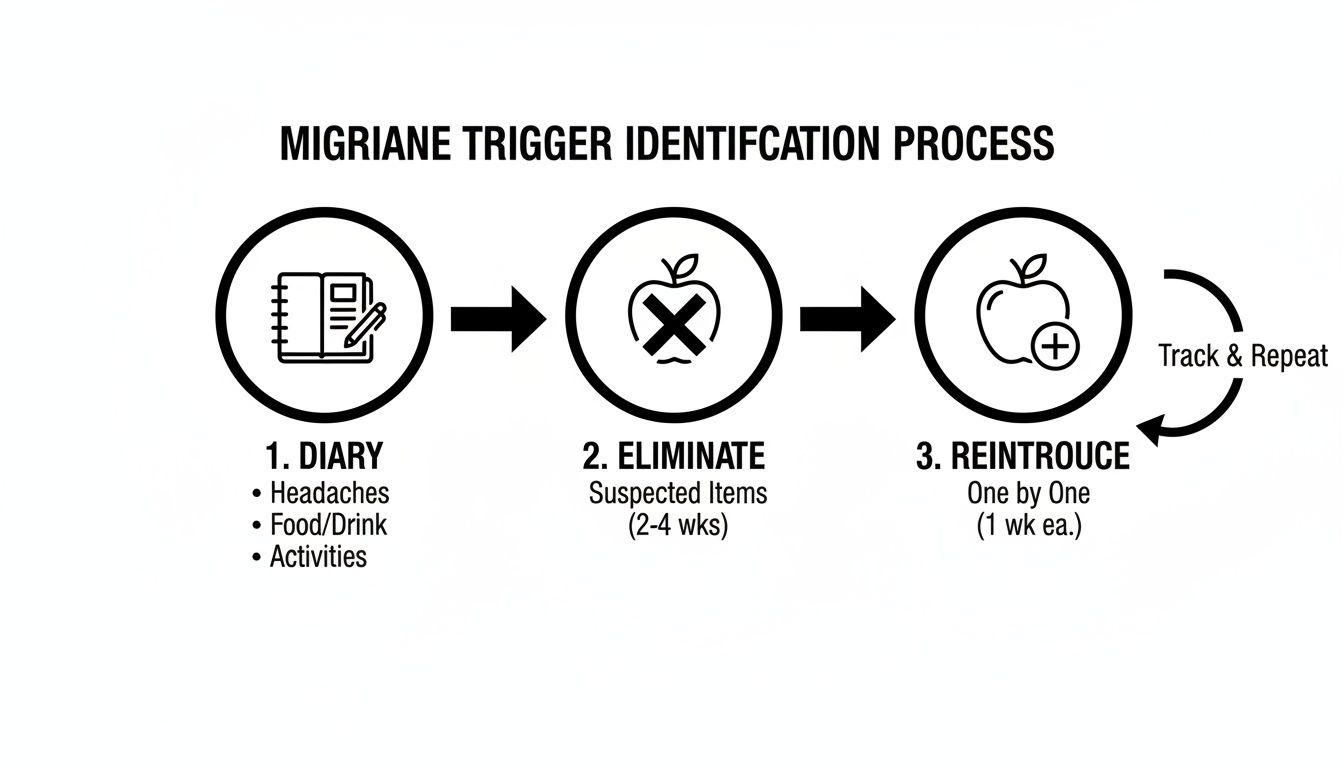
This three-stage method gives you a structured way to test your theories without putting you on a needlessly restrictive diet.
Using an Elimination Diet Safely
After a few weeks of diligent tracking, you'll likely have a list of potential suspects. The next step is a carefully managed elimination diet, which is widely considered the gold standard for pinpointing food sensitivities. You'll remove all suspected trigger foods from your diet for a set period—usually about four weeks—and monitor whether your migraine frequency or severity improves.
An elimination diet isn't about long-term restriction. It's a short-term diagnostic tool. The goal is to get clear, reliable answers so you can build a sustainable, migraine-friendly way of eating that you can actually live with.
Once the elimination phase is over, you begin to reintroduce foods back into your diet, but very slowly. You'll add just one food at a time and wait a few days to see if it causes a reaction. This methodical process is the only way to confirm with confidence which foods are genuine triggers for you.
It's so important to remember that food is just one piece of a very complex puzzle. In fact, clinical practice in Australia suggests that up to 80–90% of perceived food-migraine links are actually confused by other factors. Australian surveys consistently find that stress, hormonal shifts, and poor sleep are far more common triggers than diet alone.
Because of this, it’s always best to try and stabilise your sleep, stress, and meal schedules before or during an elimination diet. This helps you get much more accurate results. To get a better handle on this integrated approach, resources from organisations like Headache Australia can be incredibly helpful.
Building a Migraine-Resistant Diet
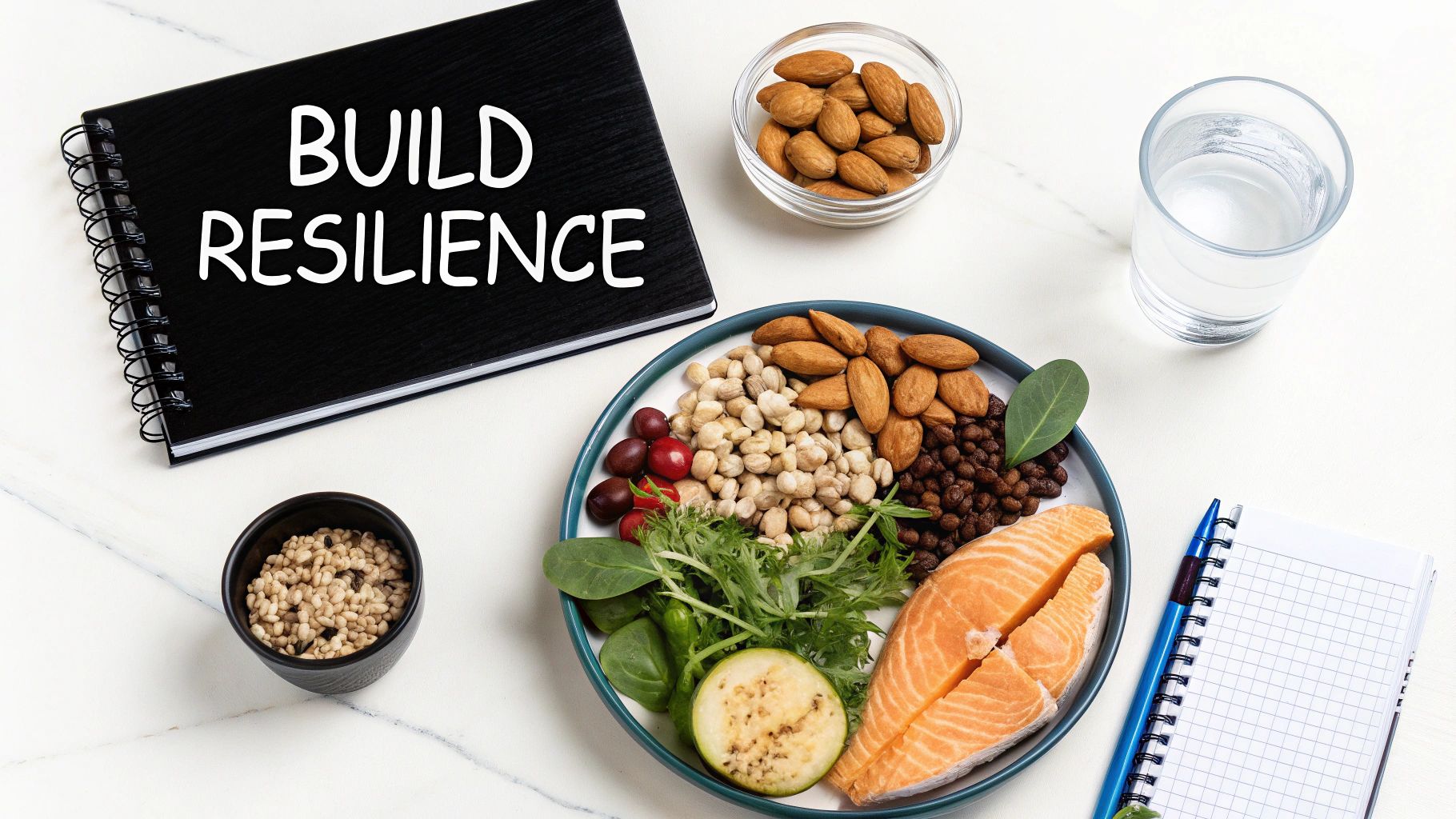
While figuring out which foods set off your migraines is a massive win, building your body's resilience is the other half of the puzzle. It’s not just about what you cut out; it’s about what you purposefully put in to strengthen your defences.
This proactive mindset flips the script from one of restriction to one of empowerment. You’re aiming to create a stable internal environment, making your brain less reactive to the triggers you can’t always avoid. Two of the simplest, yet most powerful, ways to do this are by keeping your blood sugar stable and staying properly hydrated.
Keep Your Blood Sugar Steady
One of the sneakiest and most common migraine triggers is a sudden drop in blood sugar. When you skip a meal or go too long between eating, your glucose levels can nosedive. This sends a jolt of stress right to your brain, which can easily kickstart a migraine attack.
Think of it this way: your brain needs a constant, steady drip-feed of fuel to work properly. Regular, balanced meals provide that consistent energy, preventing the sharp peaks and troughs that upset its delicate balance. It’s no surprise that many Australian headache clinics recommend eating small, frequent meals as a foundational strategy.
The Power of Proper Hydration
Dehydration is another major offender that can quickly fill up your "migraine bucket." Even being slightly dehydrated can make your blood thicker and irritate sensitive nerves in your brain, paving a fast track to an attack. Many of us are walking around chronically under-hydrated without even realising it.
A great habit to build is to keep a water bottle handy and sip from it all day long, rather than waiting until thirst hits. Herbal teas and water-rich foods like cucumber and watermelon also count towards your daily intake, helping to keep your entire system humming along nicely.
Key Nutrients for Migraine Prevention
Beyond meal timing and hydration, certain nutrients play a starring role in migraine prevention. Loading up on foods rich in these compounds can give you an extra layer of protection. If you want to actively build a diet that reduces migraine risk, checking out an anti-inflammatory meal prep guide can be incredibly helpful.
Here are a few key nutrients to focus on:
- Magnesium: This mineral is a powerhouse for calming the nervous system and has been shown to reduce how often migraines strike. You’ll find it in leafy greens, nuts, seeds, and whole grains. If getting enough through food is a struggle, you can learn more about finding the best magnesium supplement for you.
- Omega-3 Fatty Acids: Famous for their anti-inflammatory properties, omega-3s can help dial down the systemic inflammation that contributes to migraine pain. Oily fish like salmon and mackerel are fantastic sources.
- Riboflavin (Vitamin B2): This vitamin is vital for energy production within brain cells. Some studies even suggest that boosting your intake can significantly cut down on the number of migraine attacks you experience. It’s found in eggs, lean meats, and green vegetables.
Here's the rewritten section, crafted to sound more human and expert-driven, following all the provided instructions.
Putting It All Together: Living Well with Migraine
Look, managing migraines isn't about chasing a "perfect" diet. It’s about making smart, sustainable changes that actually fit into your real life. Think of it less like a strict rulebook and more like a personal investigation, where you slowly figure out how to keep your "migraine bucket" from overflowing.
The truth is, food is just one piece of the puzzle. You can avoid every known trigger food on the planet, but if you're not sleeping well, constantly stressed, or dehydrated, you're still likely to run into trouble. Getting consistent, good-quality sleep and finding ways to manage your stress are non-negotiable pillars. When those are solid, you might even find you're less sensitive to that stray piece of aged cheese.
Your food diary isn’t a chore; it’s your personal data. It's the key to unlocking a calmer, more predictable life where you're in the driver's seat, not the migraine.
Ultimately, this is all about taking back control. When you start to see the connections between what you eat, how you sleep, and how you feel, it’s incredibly empowering. You’re no longer just reacting to the pain; you're proactively building a life that helps prevent it. You're trading chaos for clarity, and that's a powerful shift.
Got Questions About Migraine Diets? Let's Clear Things Up
Diving into the world of migraine-friendly eating can feel like you've been given a complex puzzle with missing pieces. There's a lot of information out there, and plenty of it seems to contradict itself.
Let's cut through the noise and tackle some of the most common questions people have when trying to connect their diet to their migraines.
How Quickly Can a Food Trigger a Migraine?
This is one of the trickiest parts of the puzzle because there's no single answer. The window for a food-triggered migraine can be incredibly wide, ranging from as little as 30 minutes to a full 72 hours after you've eaten it.
That massive delay is exactly why keeping a detailed food diary is non-negotiable. It's easy to blame the pizza you just had for dinner, but the real culprit could be the aged cheese you had on your salad yesterday. Without a record, you're just guessing.
Do I Really Have to Give Up My Favourite Foods for Good?
Probably not, so you can breathe a sigh of relief. Think of an elimination diet as a temporary investigation, not a life sentence of bland food. The goal is simply to figure out what, if anything, is causing a problem.
Many people discover that once they manage their other migraine factors—like getting consistent sleep, staying hydrated, and keeping stress in check—their tolerance for certain foods improves. You might find you can enjoy a small amount of a previous trigger on occasion without any issue. It’s all about understanding your own personal threshold.
The aim here is progress, not perfection. Identifying your food triggers gives you the power to make smart choices, not to live in fear of your next meal.
Can a Food That Was Fine Before Suddenly Become a Trigger?
Absolutely. Our bodies are not static, and our sensitivities can shift over time. Big life changes like hormonal fluctuations (think pregnancy or menopause), a period of high stress, or even changes to your gut microbiome can make you newly sensitive to a food you've eaten for years.
This is a good reason to check in with yourself every so often. If your migraines are suddenly getting worse for no obvious reason, it might be time to revisit your diet and see if something has changed. What worked for you last year might need a little tweaking today.
When you're in the throes of a migraine and need relief that isn't from a bottle, Headache Cap is here to help. Our reusable gel caps offer the perfect combination of gentle compression and soothing cold or heat therapy to take the edge off your pain. Find the cap that’s right for you and feel the difference at https://headachecap.com.au.


