


Cervicogenic Headache Treatment: Practical Relief and Expert Tips
When it comes to treating a cervicogenic headache, simply popping a painkiller is like putting a plaster on a broken bone. It might dull the ache for a bit, but it does nothing to fix the actual problem. Real, lasting relief comes from addressing the root cause: the dysfunction in your neck. This means focusing on physiotherapy, hands-on manual therapy, and a specific exercise plan designed to get your cervical spine working properly again.
Unpacking Your Neck-Related Headache

If you're battling a stubborn headache that feels deeply connected to a stiff, sore neck, you’re definitely not alone. It’s a very common complaint. But unlike a migraine that pounds away inside your skull or a tension headache that wraps around your head like a tight band, a cervicogenic headache is what we call referred pain.
The source of the pain isn’t actually in your head—it’s in your neck.
Think of it as a case of crossed wires. When joints in your upper neck get stiff or the surrounding muscles become tight and irritated, they aggravate the local nerves. These nerves share pathways with sensory nerves from your head and face. Your brain gets confused by the signals, misinterpreting the neck problem as head pain. This is precisely why standard headache tablets often fail to provide relief; they can’t fix the underlying mechanical issue.
Key Symptoms to Watch For
Figuring out if your neck is the true culprit is the first, most crucial step. While everyone’s experience is slightly different, there are a few classic clues that point directly to a cervicogenic source.
- One-Sided Pain: The headache is almost always on one side. It typically starts at the base of the skull and travels up and over to the front, sometimes settling behind your eye or at your temple.
- Limited Neck Movement: You'll probably feel a noticeable stiffness. Trying to turn your head might reveal that one side is much tighter or more restricted than the other.
- Pain Triggered by Movement: The headache often flares up with certain neck movements or after holding a posture for too long, like hunching over a laptop or looking down at your phone.
- Pressure Point at the Top of the Neck: If you apply firm pressure with your thumb to the muscles at the top of your neck (just below the skull) on the sore side, it will often reproduce or intensify the headache.
It’s also common for people to feel related pain in the shoulder or even down the arm on the same side as the headache. In some cases, this neck-nerve connection can cause other strange symptoms. You can find out more about how neck pain and dizziness are often linked.
Understanding the Broader Impact
Headaches are a massive health issue in Australia, with estimates suggesting around 1 in 5 people deal with them weekly or more often. Cervicogenic headaches make up a big chunk of these cases but are frequently misdiagnosed as migraines or tension headaches. This confusion contributes to many of the over 1.7 million GP visits for headaches each year.
The good news is that physiotherapy, using a combination of manual therapy and targeted exercises, has a strong track record of success. It's proven to be highly effective at reducing both the frequency and severity of these headaches by getting to the source of the problem.
A cervicogenic headache isn't a primary headache; it's a secondary symptom. The real problem lies in the structures of your cervical spine. Effective treatment must focus on restoring proper joint movement and muscle function in the neck.
To help you get a clearer picture, let's compare the key features of a cervicogenic headache against other common types. The differences can be subtle, but they are vital for getting the right diagnosis and treatment plan.
Cervicogenic Headache vs Other Common Headaches
| Symptom | Cervicogenic Headache | Migraine | Tension Headache |
|---|---|---|---|
| Pain Location | One side of the head, starting from the neck | Usually one-sided, often throbbing | Both sides, like a tight band |
| Neck Involvement | Reduced neck motion, pain with movement | Neck stiffness can be a symptom, but not the cause | Neck muscles may be tight, but motion is normal |
| Primary Trigger | Neck postures and movements | Hormones, food, stress, sensory stimuli | Stress, fatigue, poor posture |
| Other Symptoms | Pain can radiate to the shoulder or arm | Nausea, vomiting, light/sound sensitivity | No other major symptoms |
Pinpointing these key differences is essential. It puts you on the right path to seeking the most appropriate and effective cervicogenic headache treatment, helping you move beyond short-term fixes and towards a lasting solution.
At-Home Techniques for Immediate Headache Relief
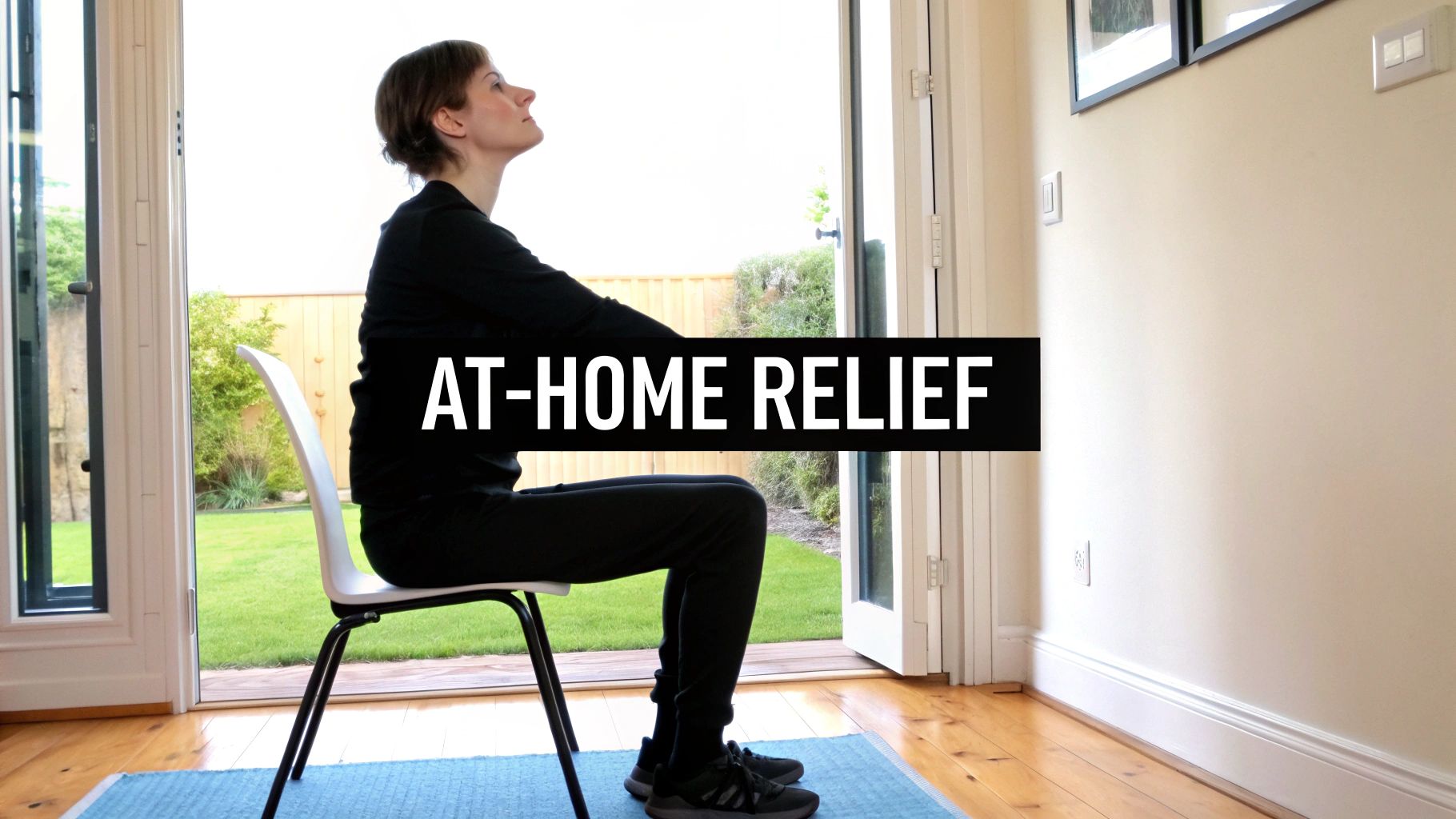
When that familiar, one-sided pain starts creeping up from your neck, the last thing you want is a complicated fix. You need something you can do right now to take the edge off. The secret is to gently address the source—the stiff joints and tight muscles in your upper neck—without making things worse.
Think of these strategies as your first line of defence during a flare-up. They’re all about offloading stressed structures, releasing muscle tension, and calming down those irritated nerves. Having these tools in your back pocket can make a world of difference while you're managing symptoms.
Finding Your Optimal Position of Ease
Often, the simplest thing is the most effective. The first step to calming a raging cervicogenic headache is to find a position that takes all the pressure off the aggravated joints in your upper spine. For most people, this means lying flat on your back with just the right amount of support.
Here’s where many people go wrong: they use a pillow that’s too high. This props your head forward, keeping the neck muscles switched on and defeating the purpose. Instead, grab a thin pillow or even a small, rolled-up towel and place it right in the curve of your neck. The goal is to let your neck completely relax and feel the pressure ease off at the base of your skull.
Gentle Stretches for Neck Tension
Once you're comfortable, you can introduce some very gentle movement. Aggressive stretching is your enemy here. We’re aiming for slow, controlled movements that coax the muscles to release, not force them into submission.
The chin tuck is a cornerstone of cervicogenic headache treatment. It's subtle but powerful.
- While lying on your back, slowly nod your head as if you're saying "yes" in slow motion.
- You’re looking for a gentle stretch right at the back of your neck, where it meets your skull.
- Hold this slight tuck for 5-10 seconds, relax, and repeat 5-10 times.
This tiny movement targets the deep neck flexor muscles, which are often weak in people with neck-related headaches. Getting them working properly helps stabilise your neck over time.
Targeted Trigger Point Release
Trigger points are those nasty, irritable knots in a tight muscle that can shoot pain elsewhere—in this case, right into your head. The main culprits are usually the suboccipital muscles (a group of small muscles just below the skull) and the upper trapezius (the big muscle running from your neck to your shoulder).
You can get at these yourself with a massage ball, tennis ball, or even your fingertips.
- Lie on your back and place the ball under the base of your skull, on the side where the pain is.
- Let the weight of your head sink onto the ball.
- When you find a tender spot, just hold that pressure for 30-60 seconds. Breathe deeply and wait for the muscle to soften and release.
This isn't about gritting your teeth through agony. The pressure should feel firm but productive—what some people call a "good pain." If you find yourself tensing up against the ball, you're pushing too hard. Back it off a bit.
Using Hot and Cold Therapy
A hot or cold pack can be an absolute game-changer for immediate relief. Which one you choose really depends on your symptoms and what feels best to you.
- Cold Therapy: Got sharp, throbbing pain? Grab a gel ice pack. The cold helps numb the area, dial down inflammation, and constrict blood vessels, which can take the "thump" out of a headache. Knowing the effective use of gel ice packs is key to getting the most out of them.
- Heat Therapy: If your pain is more of a dull, nagging ache with a lot of muscle stiffness, heat is your friend. A warm pack or a hot shower helps boost blood flow, relaxing those tight muscles and soothing the joints.
To get the full benefit, you can learn more about how to correctly use https://headachecap.com.au/blogs/health-wellness/what-is-heat-therapy-how-does-it-help. A quick safety tip: never put heat or ice directly on your skin. Always wrap the pack in a thin towel and stick to about 15 minutes at a time.
Building a Stronger Neck to Prevent Future Pain
While getting on top of the pain during a flare-up is your first priority, lasting freedom from cervicogenic headaches comes from building a neck that can handle life’s daily stresses. This isn't about quick fixes; it’s about changing the way your neck functions from the ground up. The whole point is to strengthen the specific muscles that stabilise your cervical spine, essentially giving yourself a natural, internal brace against the strains that trigger your pain.
I often tell my patients to think of their neck like a crane. You have the small, deep muscles right near the spine—these are the crucial stabilising cables. Then you have the big, superficial muscles on the surface (like your traps) that are designed for large movements. The problem is, when those deep stabilisers are weak, the big muscles try to do their job. They aren't built for it, so they get overworked, tight, and eventually, painful. Our entire rehab plan is designed to wake up and retrain those deep stabilisers.
The Foundation of Neck Strength
The starting line for any good cervicogenic headache treatment plan is mastering the deep neck flexors. These are the muscles at the front of your neck, and they’re almost always weak and underused, especially now that we spend so much time looking down at screens.
The first exercise we always start with is the chin tuck, but we focus on endurance, not just movement.
- Lie on your back without a pillow, letting your neck find a neutral, comfortable position.
- Gently nod your head forward, tucking your chin just a little, as if you’re trying to make a double chin.
- The key here is to feel the small muscles at the very front of your neck engaging. You shouldn't feel the big muscles on the sides straining.
- Hold this gentle contraction for 10 seconds, relax for 10 seconds, and repeat this 10 times.
Your initial goal is to build up to a solid 30-second hold without any shaking or feeling those larger muscles trying to take over. This simple hold is the bedrock of real neck stability.
Introducing Isometric Holds
Once you can comfortably hold a chin tuck, you're ready to add some gentle resistance. Isometrics are fantastic because you contract the muscle without actually moving the joint. This makes them incredibly safe for sensitive necks while being highly effective at building foundational strength.
You can do these sitting or standing—just make sure you maintain good posture.
- Forward Resistance: Place the palm of your hand on your forehead. Gently press your head into your hand, while your hand provides just enough resistance so that your head doesn't actually move.
- Backward Resistance: Clasp your hands behind your head. Gently press your head back into your hands, again preventing any real movement.
- Side Resistance: Place your palm on the side of your head, just above your ear. Press your head into your hand without letting it move. Do the same on the other side.
For each direction, hold the contraction for 5-10 seconds and repeat about 5 times. The pressure needs to be gentle—think only 20-30% of your maximum effort. It’s a subtle activation, not a test of strength.
Progressing to Dynamic Strengthening
As your control and endurance improve, it's time to teach these newly strengthened muscles how to work while your neck is in motion.
A brilliant exercise for this is the prone cobra.
- Lie face down on the floor. Rest your forehead on a small, rolled-up towel for comfort. Your arms should be resting by your sides with your palms down.
- Start with a gentle chin tuck, lifting your head just a centimetre or two off the towel.
- As you do that, squeeze your shoulder blades together and lift your arms off the floor, rotating your hands so your thumbs point up to the ceiling.
- Hold this position for 10 seconds. Really focus on keeping your neck long and stable.
- Slowly lower everything back down and relax completely before the next rep. Aim for a set of 10 repetitions.
This exercise is a powerhouse because it doesn't just target the neck extensors; it also strengthens the crucial postural muscles of your mid-back—the very platform your neck sits on. Improving your overall posture is a non-negotiable part of any cervicogenic headache treatment. For those looking for other gentle ways to improve posture and core stability, you might also find that some principles of Pilates for Beginners at Home complement this routine well.
This progressive approach—from simple holds to dynamic movements—is supported by strong evidence. Consistency is far more important than intensity. A little bit of the right exercise every day fundamentally changes the patterns that lead to headaches.
And this isn't just a theory; we have solid research to back it up. An Australian-based study showed that physiotherapy combining exercises like these with hands-on manual therapy leads to significant, lasting relief. In that study, many participants saw their headache frequency plummet by 80-100%, with the benefits holding strong or even improving a full year later. You can read more about these long-term physiotherapy outcomes.
While building a stronger neck is your main weapon against cervicogenic headaches, it’s always good to have strategies for other types of head pain that can pop up. To expand your self-help toolkit, take a look at our guide on finding natural tension headache relief.
Remember, investing time in these exercises is an investment in your future, helping you build a powerful defence against pain and take back control from headaches.
Navigating Professional and Medical Treatment Options
While the self-help techniques we've covered are fantastic for managing flare-ups, there often comes a point where they just don't cut it anymore. If the pain keeps coming back, gets worse, or simply won't shift, that’s your cue to bring in the professionals.
Deciding what to do next is a crucial step toward finding lasting relief.
It’s also important to know when a headache is more than just a headache. Certain symptoms are red flags that need immediate medical attention. If you suddenly get a severe headache that feels like the "worst headache of your life," see a doctor straight away. Other warning signs include a headache paired with fever, confusion, weakness, numbness, or trouble speaking. These could point to something more serious that needs an urgent look.
Assembling Your Healthcare Team
Figuring out who to see can be a bit of a maze, but each professional plays a unique part in getting you better. Your journey will likely start with one, who might then refer you on as your treatment progresses.
- General Practitioner (GP): Your GP is always the best first stop. They can give you an initial diagnosis, rule out any other underlying conditions, and prescribe medication to help manage the pain. They’re also your gateway to seeing a specialist.
- Physiotherapist: A good physio who knows their way around necks and headaches is absolutely essential. They’ll use hands-on therapy to get your joints moving properly and release those tight, angry muscles. Most importantly, they will give you a specific exercise program to strengthen your neck and fix your posture, tackling the root cause of the pain.
- Neurologist: If your headaches are particularly severe, aren’t responding to the initial treatments, or have some features that look a bit like a migraine, your GP might send you to a neurologist. They are the experts on the nervous system and can run more detailed tests to confirm what's going on and explore more advanced treatment options.
Proven Medical and Interventional Treatments
When conservative treatments like physio haven't quite done the trick, there are some powerful medical interventions that can be the next step. These are usually reserved for those stubborn cases where the pain just won't let up and is seriously affecting your life.
In Australia, we typically follow a multi-faceted path, starting with conservative care before considering anything more invasive. A standard course of physiotherapy usually involves 8-10 sessions over 6 weeks, blending manual therapy with targeted exercises. If that's not enough, we start looking at interventional procedures. You can read more about this multi-modal Australian approach to cervicogenic headache management for a deeper dive.
This decision tree gives you a great visual of how a professional will progress your neck strengthening program, starting with the basics and building up from there.
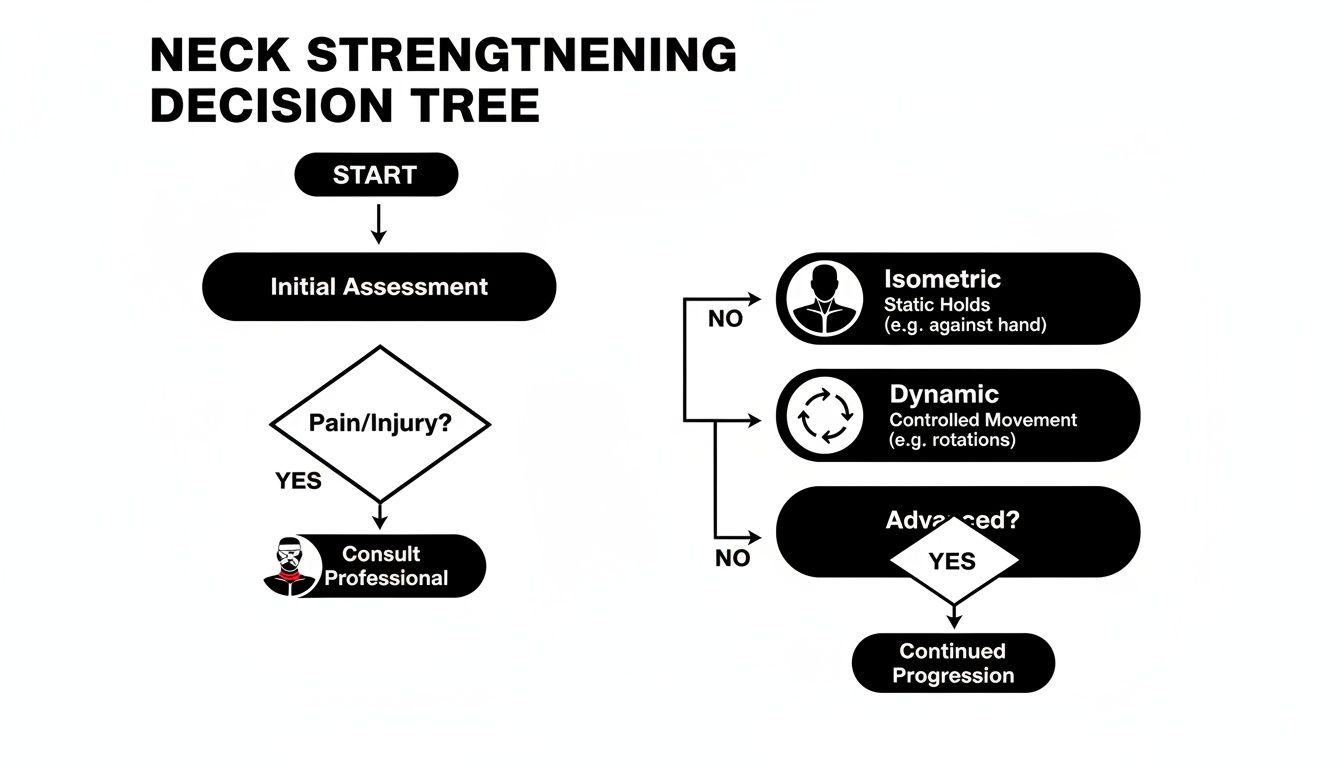
As the flowchart shows, rehab always begins with safe, static exercises to build a solid foundation. Only then do you move on to movements that challenge the muscles through their full range of motion.
Reaching out for professional help isn’t a sign of failure—it's the smartest move you can make to take back control. A structured, evidence-based treatment plan is your most reliable path to less pain and fewer headaches.
Advanced treatments often involve pinpointing the exact nerves or joints causing the problem and targeting them directly.
Nerve Blocks and Injections
A common and effective procedure is a nerve block. This is where a specialist injects a local anaesthetic, sometimes with a corticosteroid, right near the nerves at the back of the neck that are screaming out in pain. This can provide fantastic, though often temporary, relief. It also works as a diagnostic tool – if the pain disappears, we’ve confirmed exactly where the problem is coming from.
Another option is an atlantoaxial intra-articular injection, which is a highly specific injection into the C1-C2 joint at the very top of your spine. This is used when tests point to that particular joint as the main culprit.
Radiofrequency Ablation (RFA)
For longer-lasting relief, radiofrequency ablation (RFA) is a real game-changer. Also called radiofrequency neurotomy, this procedure uses a special needle to deliver a mild electrical current that heats up and stuns the problematic nerve. This basically interrupts its ability to send pain signals to your brain.
The relief from RFA can last a good 10-12 months. The nerve fibres do eventually grow back, so the procedure can be repeated if the pain returns. For many people, this treatment dramatically reduces their need for pain medication and gives them their life back. Knowing about these options means you can have a much more informed chat with your doctor about the best cervicogenic headache treatment plan for you.
Simple Lifestyle Changes for Long-Term Prevention
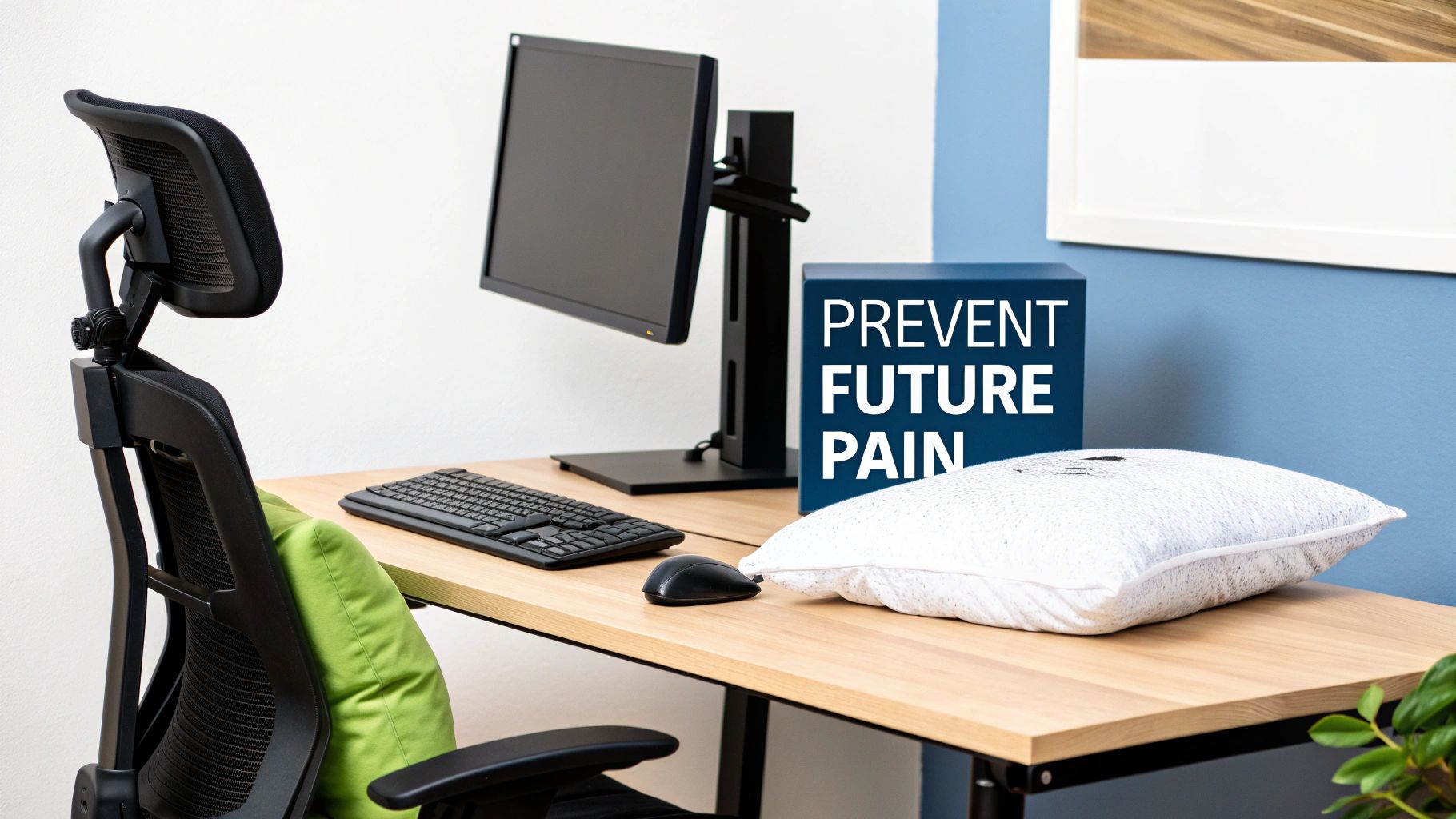
True, lasting relief from cervicogenic headaches isn’t just about what you do during a flare-up. It's built on the small, consistent habits you practise every single day. Weaving preventative changes into your routine can fundamentally alter the stresses on your neck, stopping headaches before they even have a chance to start.
It's all about creating an environment that supports your neck rather than constantly challenging it. By making a few smart adjustments to your daily life, you can dramatically reduce the chronic strain that leads to joint irritation and muscle tension—the very things that trigger this type of headache in the first place.
Optimising Your Workspace
For so many of us, the desk is where we spend a huge chunk of our day, and it's often a major culprit behind neck pain. That dreaded 'tech neck' posture—head forward, shoulders rounded—places immense strain on the upper cervical spine. A few simple ergonomic tweaks can make a world of difference.
Your goal here is to set up your workspace so that a neutral spine posture feels natural and effortless.
- Monitor Height: The top of your screen should be at or just slightly below eye level. This simple change encourages you to keep your head up and stops that constant downward gaze that loads your neck joints.
- Chair Position: Adjust your chair so your feet are flat on the floor and your knees are at roughly a 90-degree angle. Your lower back needs to be supported, either by the chair's built-in lumbar curve or even just a small cushion.
- Keyboard and Mouse: Keep them close enough that your elbows can stay comfortably by your sides, bent at about 90 degrees. Reaching forward for your keyboard is what pulls your shoulders and head forward, creating that all-too-familiar neck strain.
Small, consistent actions create the biggest long-term impact. The goal isn't to hold a perfect posture all day, but to make good posture the easiest and most comfortable option for your body.
Mastering Sleep Ergonomics
The hours you spend asleep are a crucial time for your body to repair and recover, but the wrong sleeping position can undo all your good work from the day. Waking up with a stiff, sore neck is a massive red flag that your sleep setup needs an overhaul.
The key is to maintain a neutral spine, where your head and neck are aligned with the rest of your body, not cranked at an awkward angle.
- Pillow Choice: If you sleep on your back, your pillow should be on the thinner side, just enough to support the natural curve of your neck. For side sleepers, the pillow needs to be thicker to fill the gap between your ear and the mattress, keeping your head perfectly level.
- Avoid Stomach Sleeping: This is a big one. Sleeping on your stomach forces you to twist your head to one side for hours on end. For anyone prone to cervicogenic headaches, it's one of the worst positions you can be in.
Making these adjustments helps your neck muscles fully relax and recover overnight, rather than being strained in a poor position for hours.
Simple Stress Management Techniques
Stress is a powerful trigger for muscle tension, especially in the neck and shoulders. When we're stressed, we unconsciously hunch our shoulders and clench our jaws, creating the exact pattern of tightness that can spark a headache.
Learning to manage this tension is a vital part of any preventative cervicogenic headache treatment plan.
One of the most effective tools I recommend is diaphragmatic breathing, often called belly breathing. It's a fantastic technique for calming your nervous system and consciously releasing physical tension.
Here’s how to do it:
- Find a comfortable spot to sit or lie down. Place one hand on your chest and the other on your stomach.
- Breathe in slowly through your nose for a count of four, feeling your stomach rise. The hand on your chest should stay relatively still.
- Hold your breath for a brief moment.
- Exhale slowly through your mouth for a count of six, feeling your stomach fall.
- Repeat this for 5-10 minutes each day, particularly when you feel stress levels rising.
By building these simple ergonomic, sleep, and stress management habits into your daily life, you create a powerful defence against future headaches.
Your Top Questions About Cervicogenic Headaches, Answered
When you're dealing with cervicogenic headaches, you're bound to have questions. Let's cut through the confusion with some straight answers to the things I get asked most often in the clinic.
How Long Does Physio Take to Work?
This is the big one, and the honest answer is: it depends. The timeline really hinges on how long you've been putting up with the headaches and how much your neck function has been affected. But you should definitely start to feel a shift for the better within the first handful of sessions.
As a general rule, a solid physiotherapy program should deliver a significant drop in headache frequency and intensity within about 4 to 6 weeks. Here in Australia, a typical initial treatment plan might involve 8-10 sessions over that period. We start with more hands-on manual therapy to get those stiff joints moving and calm things down, then pivot towards specific exercises to build strength and make sure the relief sticks.
Can a Chiropractor Fix My Neck Headaches?
Chiropractors can absolutely play a role in managing cervicogenic headaches. Their main technique, spinal manipulation, is designed to restore movement in the joints of the upper neck and mid-back, which are often the primary culprits.
Many people get fantastic relief from chiropractic adjustments, and there's good research backing it up for reducing how often and how badly these headaches hit. The best results, however, usually come from an approach that doesn't just focus on the joints. You also need to address the muscles and movement patterns that got you into trouble in the first place.
Expert Tip: The most successful treatment plans combine hands-on therapy with a tailored exercise program. Whether you see a physio or a chiro, make sure you're getting both to tackle the problem from all angles.
What Is the Best Pillow to Use?
There's no magic "one-size-fits-all" pillow, unfortunately. The right one for you comes down to your go-to sleeping position. The whole point of a pillow is to keep your head and neck in a neutral line with your spine, avoiding any awkward kinks that can stir up trouble overnight.
- If you sleep on your back: Look for a thinner pillow, maybe one with a bit of a contour (a cervical pillow). It needs to support the natural curve of your neck without shoving your chin towards your chest.
- If you sleep on your side: You’ll need something firmer and thicker. The goal is to perfectly fill that gap between your ear and the mattress, so your head isn't drooping down or propped up too high.
And please, try to avoid sleeping on your stomach. It forces your head to be cranked to one side for hours on end, which is one of the worst things you can do for your neck.
Are These Headaches Actually Preventable?
For the most part, yes. While you can't always stop an initial injury from happening, you can definitely reduce the chances of them coming back and manage the condition for the long haul by tackling the root causes.
Prevention all comes down to the strategies we’ve been talking about:
- Get Stronger: Sticking with your neck and postural exercises is non-negotiable. It builds the support system your neck needs.
- Sort Your Setup: Fixing your desk ergonomics and sleep environment cuts down on the daily strain.
- Stay Aware: Simply being mindful of your posture as you go about your day helps you break the bad habits that trigger the pain.
When you make these changes part of your routine, you’re actively building a more resilient neck that is far less likely to give you grief.
For immediate, drug-free relief during a flare-up, Headache Cap offers versatile hot and cold therapy gel caps designed to soothe pain and reduce tension. Discover comfortable, at-home relief and find the perfect cap for your needs at https://headachecap.com.au.


