


natural tension headache relief: Self-massage & stretches
That familiar, dull ache wrapping around your head isn’t something you just have to put up with. Natural tension headache relief is often about getting back to basics with practical, at-home strategies that tackle the real culprits—things like muscle tightness and stress—without immediately reaching for a pill.
This guide is your roadmap to feeling better, giving you simple, effective steps to manage the pain and get on with your day.
Finding Relief Without Reaching for Pills
When that tension headache starts to tighten its grip, it’s so easy to grab a painkiller. And while medication certainly has its place, it often just masks the discomfort for a little while without getting to the root of the problem. This can trap you in a frustrating cycle of recurring pain.
The good news? There are plenty of effective, natural ways to find relief. These methods are all about listening to what your body is trying to tell you through the pain. By learning a few simple techniques, you can find immediate comfort and build up your resilience against future headaches.
You're Not Alone in This
If you're dealing with regular headaches, you are far from alone. They've become a major public health issue here in Australia, affecting everything from work productivity to our general quality of life.
It's actually quite shocking: around 1 in 5 Australians, which is about 5 million people, get headaches at least once a week. Many of us rely on painkillers for a quick fix, often overlooking common triggers like neck stiffness or poor posture, which are huge contributors to tension-type headaches.
This points to a bigger issue: we’re often just managing the symptoms instead of trying to prevent them. True natural relief means shifting your focus from just numbing the pain to proactively taking care of yourself. To do that, it helps to understand what a tension headache actually is. You can learn more in our detailed guide on what is a tension headache.
Your Path to Natural Relief
Think of this guide as your starting point. We're going to walk through a variety of techniques you can start using right away.
Quick-Start Natural Relief Techniques At A Glance
Before we dive deep, here's a quick summary of the most effective and accessible natural methods you can use the moment a tension headache strikes. These are my go-to recommendations for immediate relief.
| Technique | Primary Benefit | Best For |
|---|---|---|
| Hot/Cold Therapy | Reduces inflammation & soothes muscle tension. | Immediate, localised pain relief, especially at the base of the skull or forehead. |
| Pressure Point Massage | Releases tight muscle knots (trigger points). | A dull, throbbing ache that feels connected to neck and shoulder tightness. |
| Gentle Neck Stretches | Alleviates physical strain in key trigger areas. | Headaches that build slowly throughout the day, often linked to posture. |
| Diaphragmatic Breathing | Calms the nervous system and reduces stress. | Headaches that feel directly tied to stress, anxiety, or feeling overwhelmed. |
This table gives you a snapshot, but now let's explore how to put these into practice effectively.
We'll cover everything from:
- Immediate Comfort: Quick-win methods like hot/cold therapy and self-massage for when a headache has already started.
- Releasing Physical Strain: Targeted stretches to untangle the knots in your neck and shoulders that so often spark the pain.
- Calming the Nervous System: Simple breathing and relaxation exercises to manage stress, a major headache catalyst.
- Preventative Lifestyle Habits: Small, sustainable changes to your daily routine that can make a huge difference in how often you get headaches.
By exploring these natural approaches, you're building a personal toolkit for managing pain on your own terms. It’s all about taking back control, learning to tune into your body's signals, and finding lasting relief.
Immediate Comfort Measures When a Headache Hits
When that familiar, unwelcome grip of a tension headache starts to tighten, your first instinct is to find relief, and fast. This is where some simple, hands-on techniques can be absolute game-changers, helping you dial down the pain without waiting for a pill to kick in.
Hot or Cold Therapy: Your First Line of Defence
One of the most direct and effective tools you have is temperature therapy. Whether you reach for a cold pack or a warm compress often comes down to personal preference and what your body is telling you.
Many people find that a cold compress or a chilled gel pack, like a Headache Cap, offers a welcome numbing sensation that dulls that throbbing pain, especially across the forehead or temples. The cold helps constrict blood vessels, which can sometimes calm the inflammation that’s adding to your misery.
On the flip side, warmth can be incredibly soothing for the tight muscles that are often the real culprits behind tension headaches. Try a warm compress, a heating pad, or even just letting a hot shower run over the back of your neck and shoulders. You’ll often feel the tension begin to melt away, and with it, the headache itself. If you want to dive deeper into this, you can learn more about how heat therapy helps ease muscle tightness.
This visual flow shows the simple yet powerful path to natural relief, starting with understanding your triggers, taking immediate action, and building preventative habits.
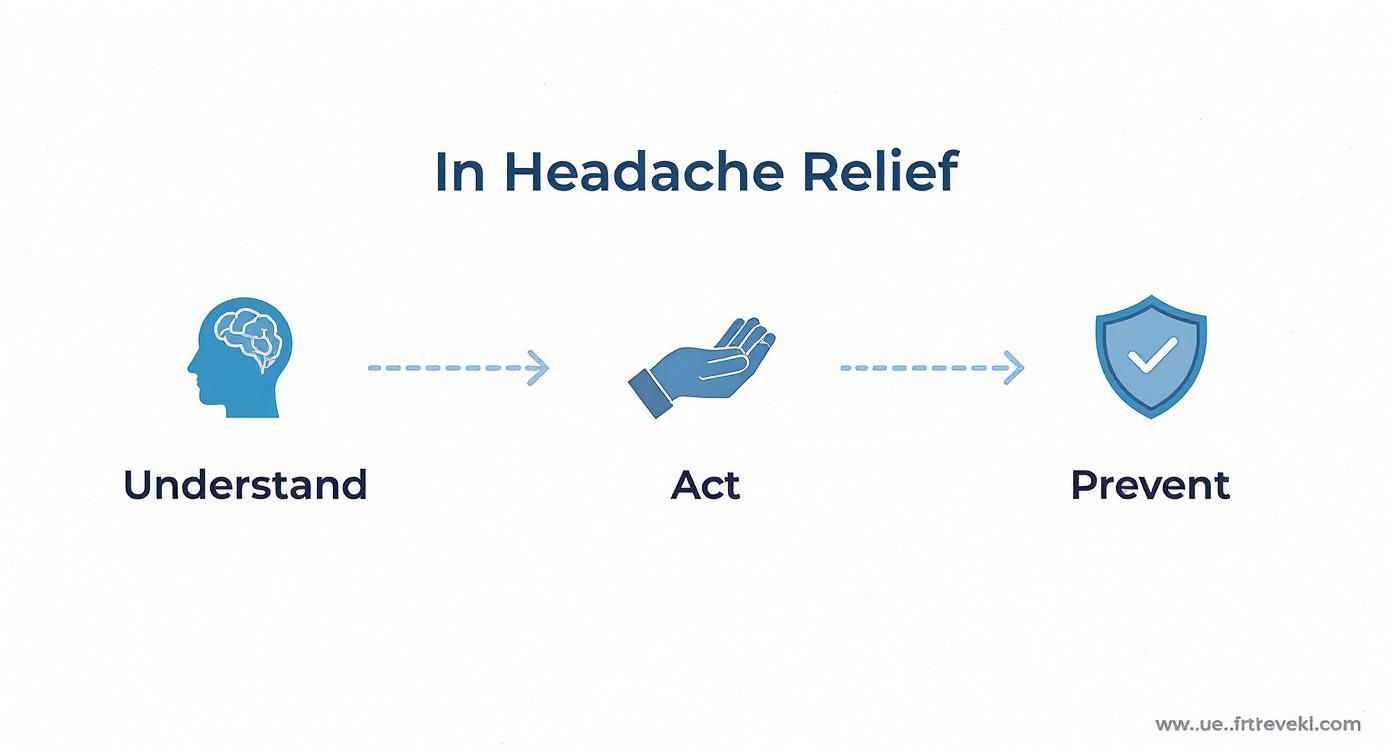
The key takeaway here is that managing headaches isn't about a one-off fix. It's a continuous cycle that blends quick relief with smart, long-term prevention.
Applying Pressure for a Quick Release
Beyond just temperature, applying direct pressure to specific points can bring about surprisingly fast relief. This is the simple principle behind self-massage and acupressure. You don't need to be an expert—a few easy moves can make a world of difference.
Often, the most effective spots are right where you feel the tension the most.
- Base of the Skull: Use your fingertips to apply firm, steady pressure in the two hollows at the base of your skull, on either side of your spine. Gently massaging here can release the suboccipital muscles, a very common headache source.
- Temples: Place your middle fingers on your temples and use gentle, circular pressure. This classic move is perfect for easing that "band-like" pain.
- Neck and Shoulders: Use your opposite hand to gently knead the tight muscles in your neck and shoulders. When you find a sore spot or knot, hold steady pressure on it for 30 seconds to encourage it to release.
Another brilliant trick is targeting the LI4 (Hegu) acupressure point, which you can find in the fleshy webbing between your thumb and index finger.
To locate it, just press your thumb and index finger together. The LI4 point is at the highest part of that muscle bulge. Apply firm pressure for a minute or two, and you’ll often feel a noticeable drop in your headache pain. It’s wonderfully discreet and easy to do anywhere—in a meeting, on the train, or just while sitting on the couch.
Creating a Calming Environment
Finally, never underestimate the power of your surroundings when a headache strikes. Tension headaches often get worse with sensory overload, so taking a few minutes to create a calm space is a powerful relief strategy in itself.
If you can, slip away to a quiet, dimly lit room for 15 minutes. Close your eyes and just focus on taking slow, deep breaths. This simple act lowers stress and gives your mind and body the break they need to recover. Combine this with a cold compress, and you've created an incredibly effective cocoon of comfort to help the pain naturally subside.
Stretches That Untangle Neck and Shoulder Knots
That familiar, nagging ache of a tension headache rarely just appears out of nowhere. More often than not, it’s the end result of tension that’s been silently building up in your neck and shoulders, especially after hours hunched over a keyboard or staring down at your phone.
When these muscles get wound up, they can be a primary trigger for that classic, band-like headache pain. The good news? You can fight back with a few gentle, targeted stretches. Think of it as proactively untangling the knots before they get a chance to tighten their grip on your head.
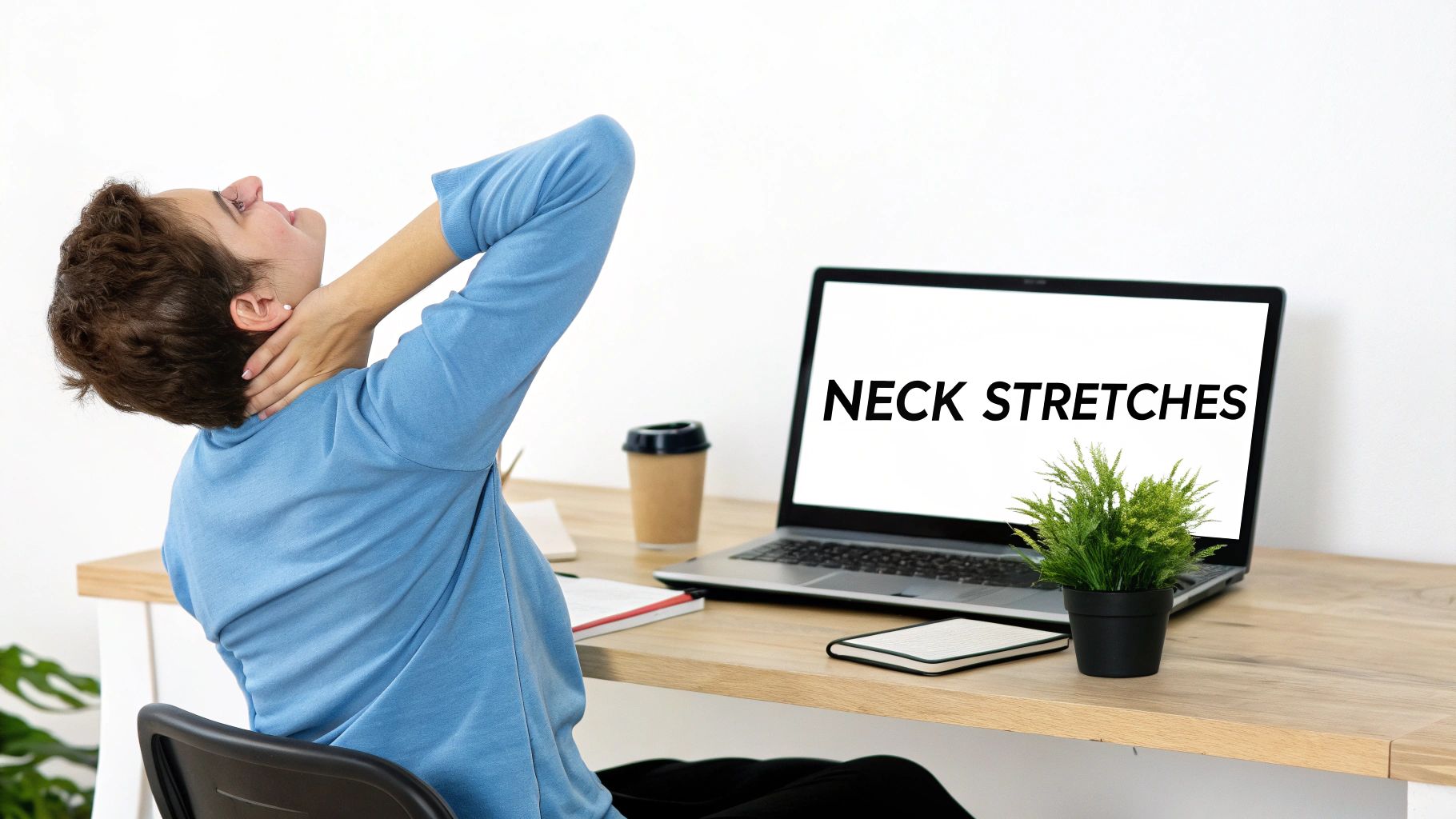
This kind of preventative care is a huge part of natural tension headache relief. Instead of just reacting once the pain hits, you’re getting ahead of it. The best part is that these stretches are so simple you can do them right at your desk in just a couple of minutes, making them an incredibly powerful tool to have in your back pocket.
Reversing the Damage of 'Tech Neck'
One of the biggest culprits behind modern neck tension is what we call "tech neck"—that forward-head slump so many of us fall into while using screens. This posture puts an incredible amount of strain on the muscles at the back of your neck.
The chin tuck is the perfect antidote. It’s a surprisingly subtle movement, but it’s remarkably effective at helping to realign your head over your spine and strengthen the very muscles that hold you in a better posture.
How to Do a Chin Tuck:
- Start by sitting or standing tall, with your gaze straight ahead.
- Without tilting your head down, gently glide your chin straight back. You're aiming to create a bit of a double chin.
- You should feel a nice, gentle stretch at the base of your skull and down the back of your neck.
- Hold this for about 5 seconds, then release. Try to do this 5-10 times.
Here's a great tip: Imagine a string is pulling the crown of your head straight up to the ceiling while you do the tuck. This little visualisation helps keep your spine long and stops you from just nodding your head down.
Doing this simple exercise a few times throughout the day is a fantastic way to interrupt the cycle of postural strain.
Easing Tightness Along Your Shoulders
Another spot where tension loves to set up camp is in the upper trapezius muscles, which run from your neck out to your shoulders. When these muscles get tight, they can send pain signals straight up into your head.
The classic side neck bend is a beautiful stretch for targeting this specific area and can offer almost immediate relief.
How to Do a Side Neck Bend:
- Get Set: Sit comfortably in a chair, with your feet flat on the floor and a straight back.
- The Stretch: Let your right ear gently drift down towards your right shoulder until you feel a comfortable stretch along the left side of your neck. There's no need to force it; the weight of your head does most of the work.
- Go Deeper (Optional): If you want a little more, you can rest your right hand on your head to add gentle pressure. For an even deeper release, try holding onto the side of your chair with your left hand.
- Hold and Breathe: Stay here for 20-30 seconds, taking nice, deep breaths. Slowly bring your head back to the centre and then repeat on the other side.
This simple movement helps to lengthen those tight muscle fibres, which in turn improves blood flow and releases all that stored-up tension. If you enjoy this kind of movement, you might also find our guide on using simple yoga poses to ease migraine pain helpful, as many of the same principles apply.
Using Your Breath to Calm Headache Triggers
https://www.youtube.com/embed/DbDoBzGY3vo
When a tension headache starts to creep in, the throbbing pain is just one part of the picture. More often than not, it’s your body's way of telling you that your nervous system is completely overloaded. Learning to control your breath is one of the quickest and most effective ways to flick the switch from a stressed-out state to a calm one, offering both immediate relief and long-term prevention.
This isn't just about taking a few random deep breaths and hoping it works. We're talking about specific, intentional techniques that actively soothe your body's stress response. When you do that, you can ease the very muscle tension that’s fuelling your headache in the first place. Think of your breath as a remote control for your nervous system.
The Power of Diaphragmatic Breathing
Most of us, especially when we’re stressed, are shallow chest breathers. Diaphragmatic breathing, or "belly breathing," is a total game-changer. It engages the diaphragm—that big muscle at the base of your lungs—to draw in fuller, deeper breaths that send a powerful "all clear" signal to your brain.
This simple shift can help lower your heart rate and blood pressure, two things that tend to shoot up when you're in pain or feeling overwhelmed. It’s a foundational skill for getting a handle on your headache triggers.
How to Practise Belly Breathing:
- Get comfortable, either sitting up straight in a chair or lying on your back.
- Place one hand on your upper chest and the other on your belly, right below your rib cage.
- Breathe in slowly through your nose for a count of four. The real focus here is on feeling your belly expand and push your hand out. Your other hand, on your chest, should stay pretty still.
- Hold that breath for just a moment, then exhale slowly through your mouth for a count of six, feeling your belly gently fall.
Aim to do this for a solid 5-10 minutes. That longer exhale is the secret sauce—it's what really activates the parasympathetic nervous system, your body's "rest and digest" mode.
This technique isn't just a rescue remedy for when a headache has already hit. Making it a daily practice, even for a few minutes, can build up your resilience to stress and make you less likely to get tension headaches in the first place.
Releasing Tension With Progressive Muscle Relaxation
Sometimes, you don't even realise how tightly you're holding onto tension until you make a conscious effort to let it go. Progressive Muscle Relaxation (PMR) is a fantastic practice that teaches you to do exactly that by methodically tensing and then releasing different muscle groups.
It’s a process that makes you incredibly aware of where you’re holding stress in your body and, more importantly, trains you to release it on command for a feeling of deep physical calm.
A Simple PMR Sequence for Headache Relief:
- Face and Jaw: Tightly squeeze your eyes shut, furrow your brow, and clench your jaw for five seconds. Now, release everything completely and let your jaw go slack. Really feel the difference.
- Neck and Shoulders: Hike your shoulders all the way up to your ears, holding that tension for five seconds. Then just let them drop completely. Feel the weight and warmth as they release.
- Arms and Hands: Make tight fists and flex your biceps and forearms for five seconds. Then, open your hands and let all that tension melt away, letting your arms feel heavy and relaxed.
You can continue this pattern all the way down through your torso, legs, and feet. By the time you’re done, your entire body should feel looser and more at ease, which can dramatically dial down the intensity of your headache.
The Body Scan Meditation for Pain Detachment
When you're in pain, it’s so easy for that sensation to take over your entire focus. A body scan meditation gives you a way to step back and simply observe the pain without getting tangled up in it. It’s a mindfulness technique where you bring a gentle, non-judgmental awareness to different parts of your body, one by one.
Instead of fighting the headache, you acknowledge it as just one of many sensations your body is experiencing. This mental shift alone can be enough to lessen its hold over you. You can find countless guided body scan meditations online to talk you through the process, which usually last between 10 to 20 minutes. The practice helps you break the pain cycle and find a sense of calm, even when the discomfort is still there.
Building a Headache-Resistant Lifestyle
While getting rid of a headache right now is the immediate goal, the real win is having fewer of them in the first place. This is where a few proactive lifestyle changes can make a world of difference. Don't think of it as a massive life overhaul. Instead, see it as making small, smart upgrades to your daily routine that build a strong defence against whatever triggers your headaches.
This shifts your whole approach from just reacting to pain to building a body that’s naturally more resilient. It all comes back to the fundamentals—hydration, sleep, nutrition—which can either feed a cycle of tension headaches or stop it before it even starts.
The Non-Negotiables: Hydration and Sleep
It sounds almost too simple, but two of your most powerful allies for natural tension headache relief are water and sleep. Dehydration is a notorious (and surprisingly common) headache trigger. When you're low on fluids, your brain can temporarily shrink and pull away from the skull, causing that familiar throbbing pain.
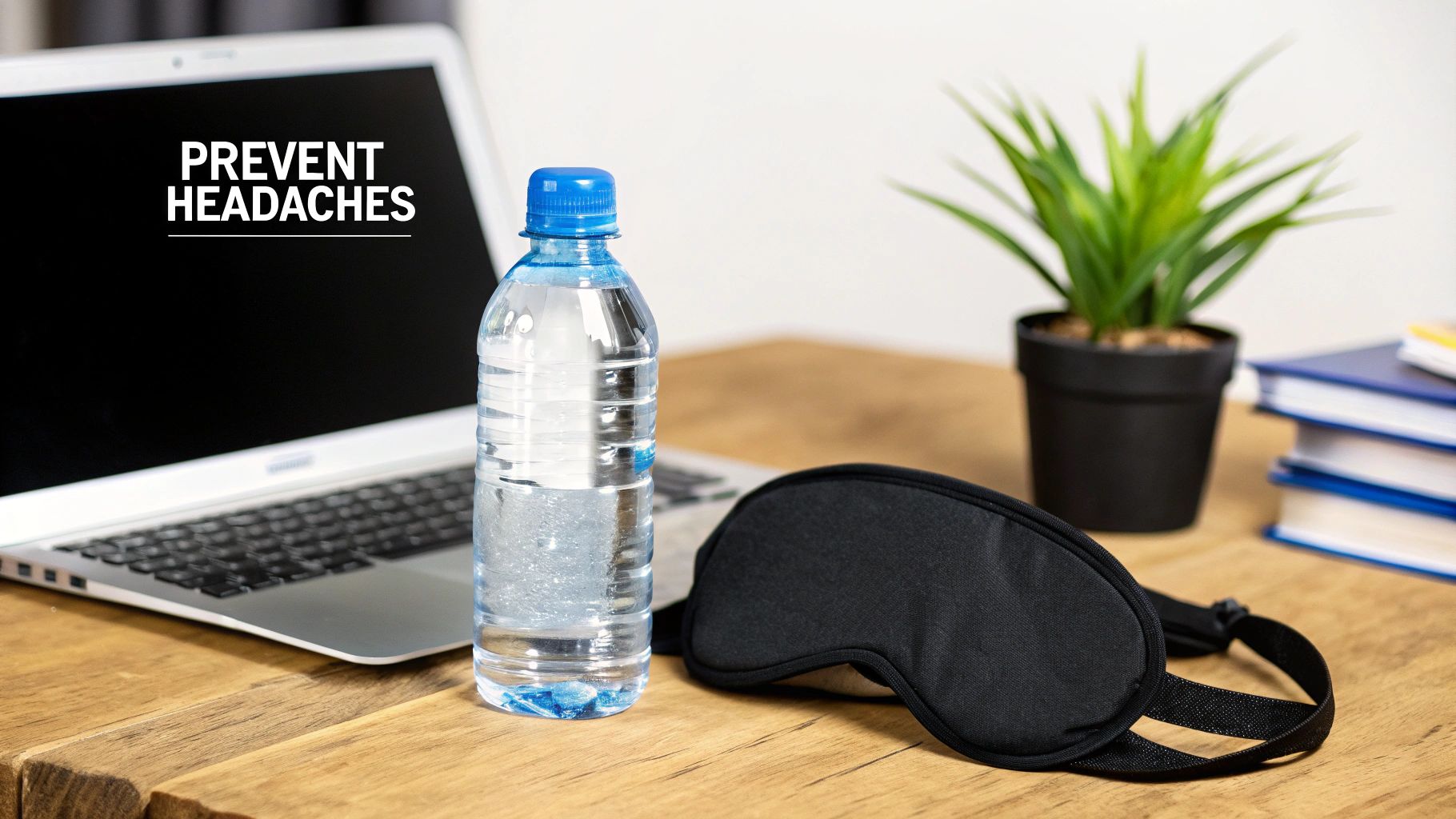
Aiming for six to eight glasses of water a day is a solid baseline. If you're someone who forgets, try setting a recurring reminder on your phone or keep a big water bottle on your desk as a constant visual nudge.
In the same way, poor sleep is a fast track to more frequent and intense headaches. Your body desperately needs that downtime to repair and reset. Aim for seven to eight hours of solid sleep a night by creating a calming wind-down routine.
- Dim the Lights: An hour before bed, lower the lights in your home. This sends a clear signal to your brain that it's time to switch off.
- Create a Screen-Free Zone: The blue light from your phone or tablet messes with your body's melatonin production. Put screens away for at least 30-60 minutes before you hit the pillow.
- Keep it Consistent: Try to go to bed and wake up around the same time each day—yes, even on weekends. This helps regulate your body's internal clock.
These habits might seem small on their own, but their cumulative effect is huge. They stabilise your body’s internal systems, making you far less susceptible to the physical and mental stressors that often kick off a tension headache.
Is Your Workspace a Headache Trigger Zone?
For many of us, our desk is where tension is born and bred. We spend hours hunched over a laptop, head pushed forward, putting a huge amount of strain on our neck and shoulder muscles. This is a classic pathway to a pounding headache. An ergonomic setup isn't a luxury; it's a preventative necessity.
The goal is to create a neutral posture where your joints are naturally aligned, which takes the pressure off your muscles.
Your Ergonomic Checklist for a Headache-Free Desk:
- Monitor at Eye Level: Your screen should be directly in front of you, with the top of it sitting at or just below your eye level. You shouldn't have to tilt your head up or down to see it.
- Elbows at 90 Degrees: Adjust your chair so your feet are flat on the floor and your elbows rest at a comfortable 90-degree angle when you're typing.
- Back Support is Key: Make sure your lower back is supported by your chair's lumbar curve. If your chair is lacking, a small cushion or rolled-up towel can work wonders.
Making these small tweaks can dramatically slash the daily physical stress that builds into chronic head pain.
Mindful Eating to Minimise Triggers
What you eat—and just as importantly, when you eat—can play a surprisingly big role in how often headaches strike. Skipping meals can cause your blood sugar to dip, which is a well-known headache trigger for many people. At the same time, a diet heavy on processed foods can contribute to low-grade inflammation, making your body more sensitive to pain signals.
Try to focus on whole, anti-inflammatory foods like leafy greens, fatty fish (like salmon), nuts, and fruits. Also, be mindful of your caffeine intake. Both having too much and suddenly stopping can spark a headache. If you're a regular coffee drinker, the key is consistency.
The challenge of managing headaches is a massive public health issue. A 2023 Australian study confirmed that tension-type headaches are incredibly common, with an adjusted one-year prevalence of around 31%. That means nearly one-third of Australians are dealing with this annually, which really highlights the need for accessible and effective natural relief methods like the ones we've talked about. If you want to dive deeper, you can explore the full findings from the Australian Headache Epidemiology Data study.
By paying closer attention to these daily habits, you're not just treating symptoms. You're actively building a foundation of health that makes your body less prone to headaches in the first place. It's a powerful, sustainable way to find lasting relief.
Your Questions on Natural Relief, Answered
As you start exploring these natural techniques, it’s completely normal to have a few questions. Getting a handle on how to use these methods safely and effectively is a massive part of finding real relief from tension headaches. So, let's clear up some of the common things people ask.
This is all about giving you the practical know-how to make these strategies work for your body and your specific situation.
How Quickly Can I Expect These Methods to Work?
This is the big one, isn't it? The honest answer is: it really depends. Some of the more immediate techniques, like applying a cold pack or pressing on the LI4 acupressure point on your hand, can start to dial down the pain within 15 to 30 minutes. You might just notice the sharp edges of the ache beginning to soften.
Other methods work in two ways—they help right now and they help in the long run. A good stretching session, for example, can unlock that neck and shoulder tension immediately. But making it a regular habit is what really builds your resilience and helps stop headaches from starting in the first place.
I always tell people to think of it this way: the quick-win techniques are your emergency kit for when a headache hits. Things like stretching and mindful habits are your long-term prevention plan. The more you practise them, the less you'll need the emergency kit.
Are These Natural Methods Safe During Pregnancy?
Many natural approaches are fantastic options during pregnancy, particularly when you’re looking to avoid or limit medications. Things like gentle stretches, staying well-hydrated, deep breathing exercises, and simply focusing on good posture are generally very safe and incredibly helpful.
That said, it is absolutely essential to chat with your doctor or a trusted physio before you start anything new. Certain acupressure points, for instance, are a definite no-go during pregnancy.
Above all, listen to your body. If a stretch or position feels even slightly off, stop. When you're using hot or cold therapy, do it for shorter periods and never, ever place it directly on your belly. Your safety and comfort always come first.
What if I Have a Really Sensitive Scalp or Skin?
This is a great question. For anyone with heightened sensitivity—like people who experience allodynia, where even a light touch can be painful during a headache—some of these techniques need a much softer touch. A direct, firm massage is probably going to be too much.
Instead, you can pivot to methods that don't require direct pressure on your head.
- Breathing Exercises: Deep belly breathing and body scan meditations are perfect. They work by calming your entire nervous system without any physical contact.
- Gentle Stretches: Concentrate on releasing tension in your shoulders and upper back. Loosening up these areas can have a powerful downstream effect on head pain.
- Temperature Therapy: Try a soft, flexible cold pack like a Headache Cap. It provides a gentle, diffused cooling sensation that’s often much more tolerable than a rigid, hard ice pack.
The whole idea is to adapt these tools to what feels good for you. The goal is always relief, never adding more pain to the situation.
When Should I See a Doctor for My Tension Headaches?
While these natural strategies are brilliant for managing most tension headaches, there are definitely times when you need to get a professional medical opinion. It's time to book an appointment with your GP if your headaches suddenly change, becoming much more severe or happening far more often than usual.
You should also see a doctor right away if your headache comes with any of these other symptoms:
- A fever and a stiff neck
- Confusion or trouble getting your words out
- Changes in your vision, or numbness anywhere in your body
Any headache that starts after a knock to the head needs immediate medical attention. And finally, if your headaches are just really getting in the way of your life and these natural methods aren't quite cutting it, a doctor can help rule out other causes and work with you on a more comprehensive plan.
Ready to experience fast, soothing relief the next time a headache strikes? The Headache Cap delivers gentle, 360-degree cold or hot therapy exactly where you need it, creating a dark, quiet cocoon of comfort. Discover your perfect fit and take control of your headache relief by visiting us at https://headachecap.com.au.


