


Himalayan Rock Salt What You Need to Know
Himalayan rock salt is a type of unrefined, mineral-rich salt mined from ancient seabeds, easily recognised by its distinctive pink colour. Unlike the highly processed table salt we're all used to, it's minimally touched, which means it keeps its unique mineral profile – a quality that many people believe gives it a special edge in both flavour and wellness.
What Is Himalayan Rock Salt and Why Is It Pink?
This beautiful pink salt is a true geological marvel, a little piece of an ancient ocean preserved deep within the earth. It's harvested mainly from the Khewra Salt Mine in Pakistan, right at the foothills of the Himalayas. Think of it as fossilised sea salt. Millions of years ago, a huge inland sea dried up, leaving behind massive salt deposits that were eventually buried by shifting landscapes, sealing them away from modern-day pollution.
This pristine, protected environment is what makes this salt so special. While standard table salt goes through heavy refining and is often treated with anti-caking agents, Himalayan salt is simply mined in large, stone-like slabs and left in its natural state. This hands-off approach preserves its raw form, making it a go-to for kitchens and wellness practices worldwide. It's a popular import here in Australia, too. In fact, between October 2023 and September 2024 alone, Australia brought in 95 shipments of Himalayan salt from Pakistan, as you can see from import data on Volza.com.
The Science Behind the Pink Hue
The first thing anyone notices about Himalayan rock salt is its stunning pink-to-orange colour. This isn't an artificial dye; it's a direct result of its rich mineral content. The colour comes mainly from traces of iron oxide—the very same compound that gives rust its reddish look.
Beyond iron oxide, the salt also contains dozens of other trace minerals. Some of the key ones include:
- Potassium
- Magnesium
- Calcium
It's important to remember that these minerals are present in tiny amounts. But the iron oxide is just enough to colour the salt crystals, creating that beautiful spectrum of shades from pale pink to a deep, vibrant rose.
Think of it this way: each crystal of Himalayan salt is a tiny time capsule from an ancient sea. Its unique colour tells the story of the specific minerals that were trapped inside as it formed.
This infographic breaks down the salt's core features at a glance.
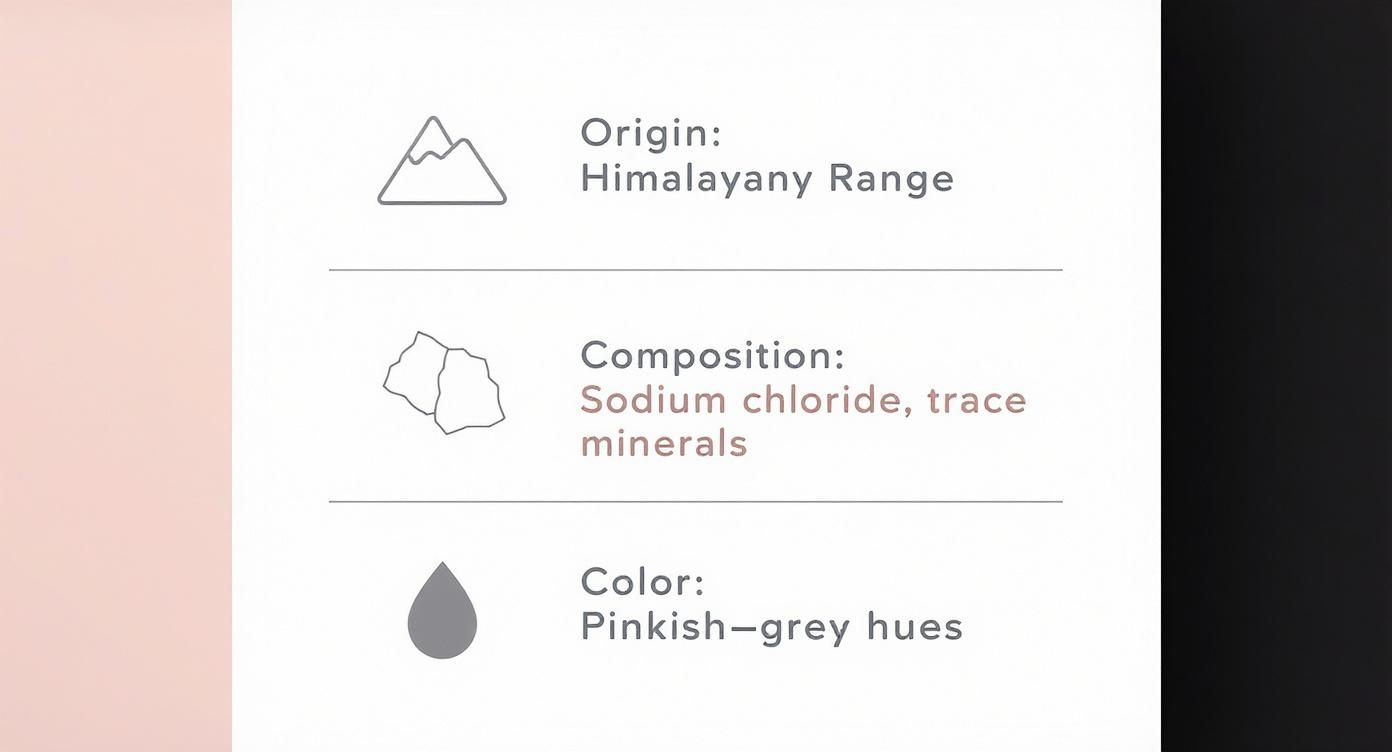
As the visual shows, the salt’s origin, mineral makeup, and signature colour are all connected, stemming directly from its ancient geological history. This natural sourcing and composition are what truly set it apart from its highly processed cousins on the supermarket shelf.
Himalayan Rock Salt vs Table Salt At a Glance
So, how does this pink salt stack up against the regular white stuff in your shaker? Here’s a quick comparison to highlight the key differences.
| Feature | Himalayan Rock Salt | Table Salt |
|---|---|---|
| Origin | Mined from ancient sea salt beds in Pakistan. | Sourced from underground salt mines or evaporated seawater. |
| Composition | 98% sodium chloride plus trace minerals like iron, calcium. | Almost pure sodium chloride; often stripped of other minerals. |
| Processing | Minimally processed, unrefined, and free of additives. | Highly refined, bleached, and treated with anti-caking agents. |
| Colour & Texture | Ranges from white to deep pink with coarse, irregular crystals. | Uniformly white with fine, consistent granules. |
| Additives | None. It's pure, natural salt. | Typically contains added iodine to prevent deficiency. |
| Flavour | Often described as having a subtler, more complex taste. | A sharp, straightforward salty taste. |
Ultimately, while both are primarily sodium chloride, the journey from the earth to your table is vastly different. Himalayan salt retains its natural character, whereas table salt is processed for uniformity and fortified with iodine.
What's Actually in Pink Salt? A Look at its Mineral Profile
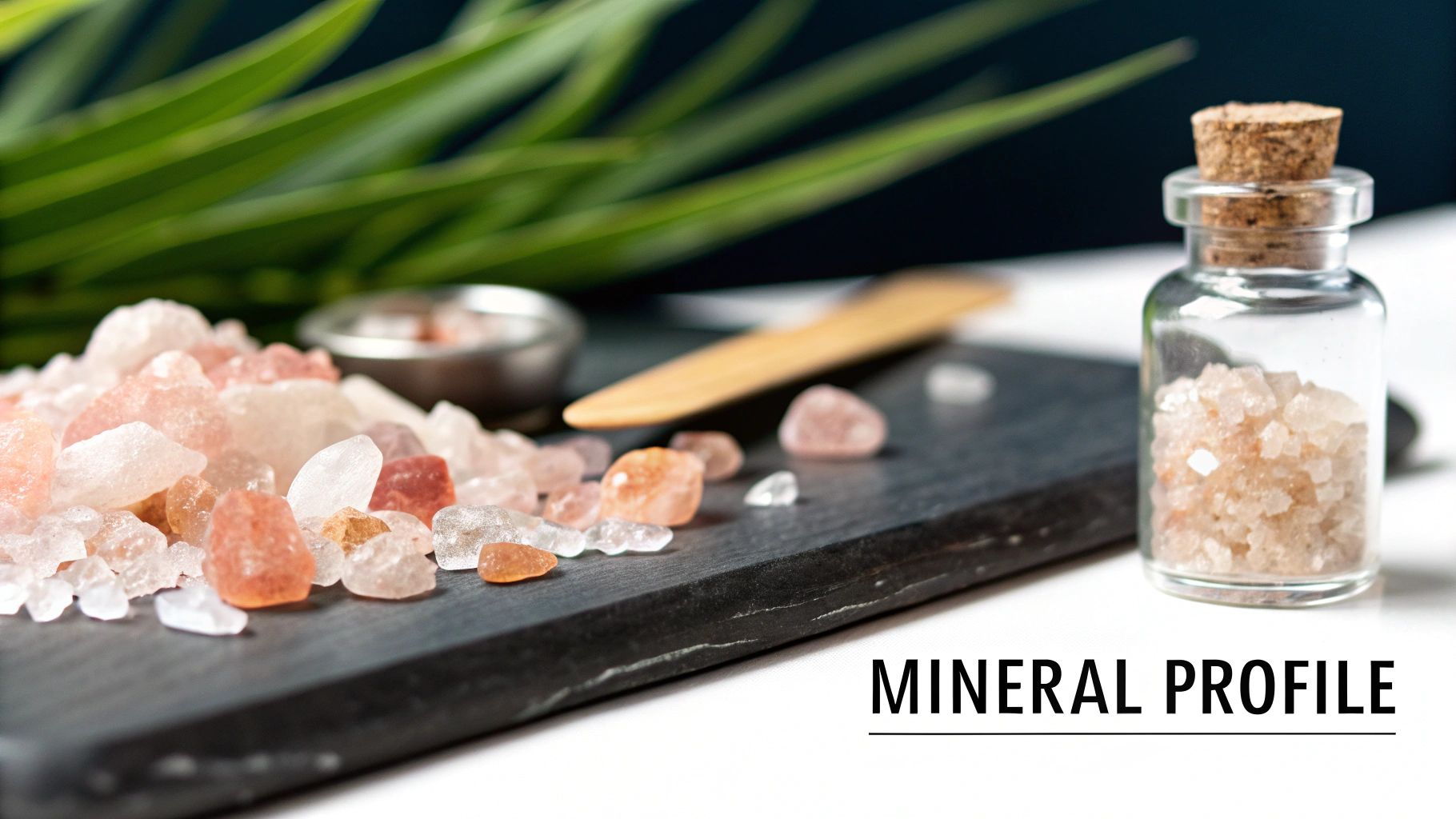
The first thing you’ll hear about Himalayan salt is that it contains 84 different trace minerals. It’s a compelling marketing line, and it’s the reason for that gorgeous pink colour. But what does "trace" actually mean when it comes to nutrition?
Let's break it down. Around 98% of Himalayan rock salt is just sodium chloride. That’s the exact same chemical compound that makes up everyday table salt. The other 2% is where you'll find that long list of minerals. This tiny fraction includes good stuff like potassium, magnesium, and calcium, all of which our bodies need to function.
But the key word is trace. The amounts are so incredibly small that they have virtually no impact on your daily mineral intake. Think of it like adding a single drop of cordial to a swimming pool—the flavour is technically in there, but you’d never be able to taste it.
Putting the Minerals into Perspective
To really get a sense of this, let's talk numbers. While the minerals are responsible for the salt’s unique colour and subtle flavour, the health benefits are often blown way out of proportion.
The real value of Himalayan salt's mineral profile isn't about nutrition. It's about what it represents: a natural, unrefined product. Unlike heavily processed table salt, it hasn't been stripped of these elements, no matter how tiny they are.
For instance, a normal serving of Himalayan salt would give you less than 0.1% of the magnesium or calcium you need for the day. You'd have to eat a dangerously high amount of salt to get any real nutritional boost from these minerals.
The Key Minerals in That Tiny 2%
So, which minerals are we actually talking about? While the list of 84 is extensive, only a few are noteworthy. Here are the main players you’ll find in that remaining 2%.
- Potassium: An absolute must for balancing fluids in the body and making sure your muscles contract properly.
- Magnesium: A workhorse mineral involved in over 300 essential bodily reactions, from nerve signalling to creating energy.
- Calcium: Famous for building strong bones, but it’s also critical for a healthy heart and well-functioning muscles.
- Iron: This is the big one responsible for the salt's signature pink hue. It’s also crucial for carrying oxygen around your body in your blood.
While these minerals are definitely present, trying to use Himalayan salt as a supplement just isn't a practical health strategy. Its true benefit comes from being an unrefined, natural product for your kitchen—not a nutritional powerhouse. The trace minerals are more of a fascinating geological fingerprint than a health supplement.
How to Use Himalayan Rock Salt in Your Kitchen
Alright, let's move from the science into the kitchen. This is where Himalayan rock salt really shines, offering a completely different sensory experience than your standard table salt. Its coarse, crunchy texture and nuanced, mineral-rich taste stand in sharp contrast to the one-note, aggressive bite of highly refined salt.
These qualities make pink salt a fantastic and surprisingly versatile tool in your culinary arsenal. The larger crystals don't just melt away instantly like fine-grained salt. This slower dissolve rate means they provide a satisfying crunch and a milder pop of saltiness, making it much harder to accidentally oversalt a dish. It’s this very characteristic that opens up a world of possibilities, especially when it comes to presentation and the final touches.
Using Pink Salt as a Finishing Touch
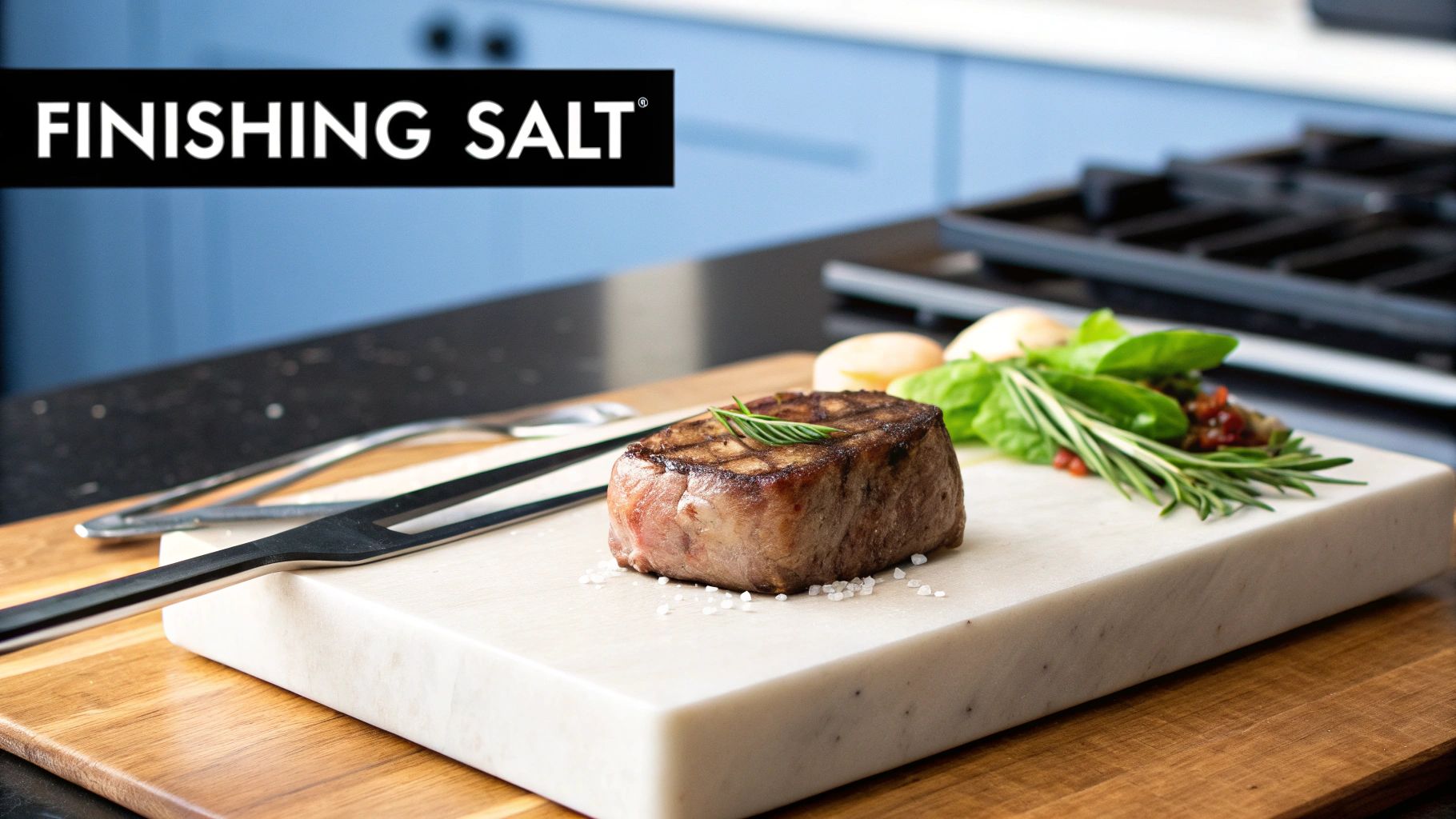
One of the best and most common ways to use Himalayan rock salt is as a finishing salt. Think of it as the final flourish—a sprinkle of crystals scattered over a dish right before it's served. This simple step lets the salt's unique character take centre stage, adding a pop of flavour and a beautiful texture that can elevate an entire meal.
Here are a few ways to get started:
- Grilled Meats and Seafood: A generous pinch over a resting steak or a perfectly grilled piece of salmon adds a delicate crunch that complements the meat's natural savoury notes.
- Fresh Salads and Vegetables: Forget dissolving salt in a dressing. Tossing a little pink salt over a fresh salad or roasted veggies gives you these little bursts of flavour that play beautifully with the fresh ingredients.
- Sweet Treats: This is where the magic happens. A few crystals on top of a gooey chocolate brownie or drizzled over caramel creates that incredible sweet-and-salty combination that really wakes up your palate.
The whole point of a finishing salt is to add that last layer of complexity. Its coarse texture means you get little pops of saltiness here and there, rather than a uniform taste, making every bite a bit more interesting.
Cooking on a Himalayan Salt Block
If you're feeling a bit more adventurous, cooking directly on a Himalayan salt block is an amazing way to gently infuse food with a delicate, savoury flavour. These solid, dense blocks of salt can be heated or chilled to extreme temperatures, turning them into a spectacular cooking surface.
To sear on a salt block, the key is to heat it slowly and evenly to prevent it from cracking—this is non-negotiable. Start it on a very low heat and gradually raise the temperature over about 30–45 minutes. Once it's searing hot, you can cook thin slices of steak, prawns, or scallops right on the block. The food cooks in a flash and picks up a subtle, perfectly seasoned saltiness that you just can't get any other way.
Beyond the incredible flavour, it’s a show-stopping centrepiece for a dinner party.
Himalayan Salt Health Claims: Myth vs. Reality
Himalayan rock salt has a certain magic to it, doesn't it? It’s surrounded by an impressive number of health claims, from balancing your body’s pH to purifying the air in your home. It’s easy to get swept up in the wellness buzz, but we need to separate the marketing hype from the scientific reality.
So, let's take a clear-eyed look at what’s fact and what’s fiction.
At its core, any salt—including the pink stuff—is primarily sodium chloride. While those trace minerals give it that beautiful colour, they’re present in such tiny amounts that they don't really change its fundamental chemical nature. This is a crucial point to remember as we dive into its supposed health powers.
Does Pink Salt Detoxify or Balance pH Levels?
This is probably one of the most persistent claims out there: that Himalayan rock salt can detoxify your body and balance its pH. The theory often involves drinking a salt solution called "sole," which supposedly flushes out toxins. Unfortunately, there's just no scientific evidence to support the idea that any type of salt water can perform a "detox."
Your body already has an incredibly efficient detoxification system—your liver and kidneys work around the clock to filter and get rid of waste. They've got it covered.
Likewise, the idea that salt can alter your body’s pH is a myth. Our bodies are amazing at tightly regulating their own pH, keeping blood at a steady 7.4. Your diet has very little impact on this. In fact, consuming too much salt, regardless of its colour, just puts more strain on your kidneys.
Can It Really Improve Your Sleep?
Another popular belief is that Himalayan salt can lead to better sleep. This is often linked to its mineral content, especially magnesium, which does play a role in relaxation. But here's the catch: the amount of magnesium in Himalayan rock salt is far too low to have any noticeable effect.
You’d have to eat a dangerously high amount of salt to get a meaningful dose of magnesium from it. If you're looking into minerals for better sleep, it’s much more effective to get them from other sources. Our guide on the best magnesium supplements offers more practical advice for anyone trying to improve their rest.
The Truth About Himalayan Salt Lamps
Himalayan salt lamps are undoubtedly beautiful. They cast a warm, calming glow that can make any room feel cosier. Marketers often tout them as natural air purifiers that release negative ions, supposedly clearing out dust, pollen, and other pollutants.
It's true that salt is hygroscopic, meaning it attracts water molecules from the air. However, the effect of one small lamp is pretty minimal. There is very little scientific evidence proving they can generate enough negative ions to actually purify the air in a room or offer significant health benefits.
So, what are they good for? Their primary benefit is aesthetic. That gentle, warm light can certainly create a relaxing atmosphere, which might help reduce stress and promote a sense of wellbeing—much like a candle or a dimmer switch.
But the bigger claims about fixing respiratory conditions or counteracting electromagnetic radiation just aren't backed by solid research. The reality is, Himalayan rock salt is a wonderful, natural alternative for your kitchen, but its broader health claims should be taken with, well, a grain of salt.
Sourcing and Safety for Australian Consumers
When you’re grabbing a bag of Himalayan rock salt from the shelf, its journey from a mine in Pakistan to your pantry in Australia is a detail worth paying attention to. The source and how the salt is handled can make a big difference to its quality and, more importantly, its safety. Because it's a natural, unrefined product, it can sometimes bring along a few unwanted guests from its ancient geological home.
This means that not all pink salts are created equal. While its rich mineral profile is what makes it so popular, the potential for contaminants like heavy metals is a real concern. Knowing what to look for—and what to steer clear of—is your best bet for making a smart choice.
Reading Labels and Spotting Quality
Before you pop that salt into your trolley, take a second to give the packaging a good look. Trustworthy brands are usually upfront about where their product comes from and what’s in it.
Here’s a quick checklist for the label:
- Country of Origin: True Himalayan rock salt will always be listed as a product of Pakistan. This tells you it’s from the right neck of the woods.
- Purity Claims: You'll often see phrases like "100% pure" or "unrefined." These sound great, but be aware they aren't always officially regulated.
- Food-Grade Certification: This one’s a biggie. Make sure the salt is clearly marked as "food-grade." This confirms it's safe to eat, unlike the salt sold for lamps or bath soaks.
Here’s the thing, though: that pretty pink colour isn't always a foolproof sign of purity. Some pretty eye-opening research has shown this. An investigation by Nutrition Research Australia (NRAUS) tested 31 pink salt samples available right here in Australia and found some worrying levels of contaminants. This included lead concentrations up to 130 times higher than in regular white table salt, with a few samples even exceeding the safety limits set by Food Standards Australia and New Zealand by 25%. If you want to dive deeper, you can check out more data on the Himalayan salt market from Straits Research.
This research is a powerful reminder that we need to be a bit savvy. Sticking with trusted brands that are open about their sourcing is the simplest way to make sure the Himalayan rock salt you bring home is safe for you and your family.
Australian Pink Salt Alternatives
While Himalayan salt travels a long way to get here, Australia has its own amazing pink salt sources. These local options not only have their own unique flavours and textures but also come with the peace of mind of local quality standards. Choosing them is a great way to support Australian producers and add something special to your cooking.
Australian Pink Salt Sourcing Guide
To help you navigate the options, here’s a quick look at some of the different pink salts you can find in Australia.
| Salt Type | Origin | Key Features |
|---|---|---|
| Himalayan Rock Salt | Khewra Salt Mine, Pakistan | Famous pink hue from iron oxide, coarse texture, and a subtle mineral taste. |
| Murray River Pink Salt | Murray-Darling Basin, Victoria/NSW | Delicate, flaky crystals with a mild flavour. Its peach-pink colour comes from carotene. |
| Lake Tyrrell Pink Salt | Lake Tyrrell, Victoria | Crisp, saline taste with fine to coarse grains, naturally harvested from a salt lake. |
In the end, whether you opt for authentic Himalayan rock salt or a home-grown Aussie alternative, the goal is the same: enjoying a pure, flavourful product. By reading labels carefully and considering what’s produced locally, you can feel confident you’re making a safe and delicious choice for your kitchen.
Wellness Uses for Himalayan Salt at Home
Beyond the kitchen, Himalayan rock salt has become a staple in many home wellness routines. It’s always good to keep expectations realistic, but there are definitely a few practical ways it can complement your self-care rituals, especially when it comes to relaxation and gentle cleansing.
These uses are less about unproven health claims and more about the simple, physical properties of the salt itself—things like its texture and its ability to dissolve in water. By focusing on what we know works, you can safely add this natural mineral to your home wellness toolkit.
Creating a Soothing Salt Bath
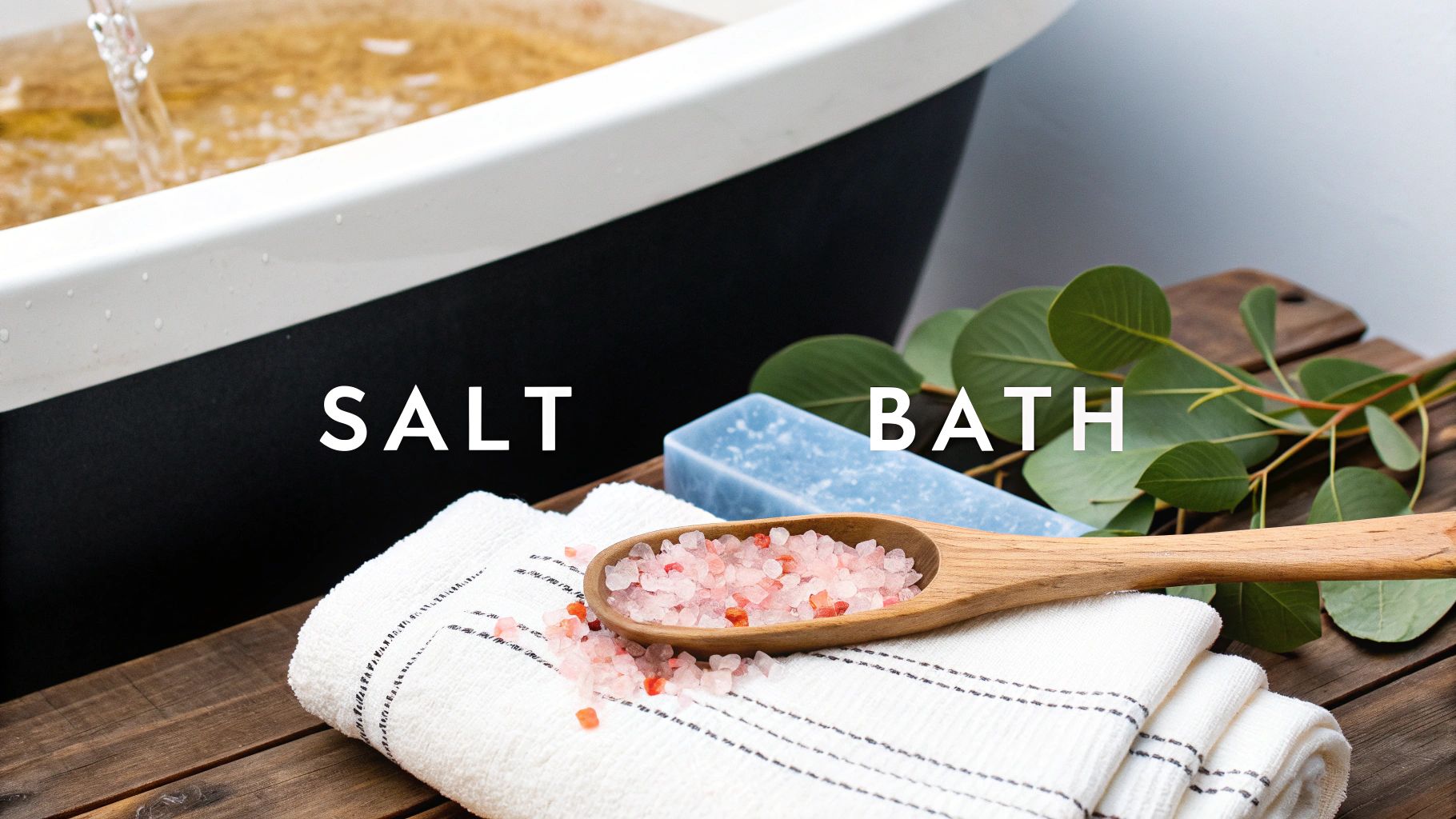
One of the most popular ways to use Himalayan rock salt is in a warm bath. Adding some coarse salt to the tub can be a wonderfully soothing experience, helping to soften your skin and relax sore, tired muscles after a tough day. It's the combination of warm water and salt that provides such a simple yet effective way to unwind.
Getting it right is easy:
- Measure it out: Simply add about one cup of coarse Himalayan rock salt to a standard-sized bathtub as the warm water is running.
- Help it dissolve: Give the water a good swirl with your hand to make sure the salt crystals have fully dissolved before you hop in.
- Soak and relax: Settle in for a good 15–20 minutes. This gives your skin time to soften and your muscles a chance to ease up.
To really dial up the relaxation, you could try pairing your salt bath with other comforting methods. For example, our guide on making your own DIY heat pack is another fantastic way to soothe muscle tension right at home.
A warm salt bath isn't a miracle cure, but it is a simple, tangible way to create a moment of peace. Think of it as a physical ritual that signals to your body it’s time to slow down and de-stress.
Preparing a Saline Sinus Rinse
A saline solution is a long-trusted remedy for clearing stuffy noses and calming irritated sinuses. You can easily buy pre-made solutions, but it's also quite simple to make one at home with some fine-grain, food-grade Himalayan rock salt. A gentle rinse can help flush out mucus and allergens, offering welcome (if temporary) relief.
To make a safe solution, just mix 1/4 teaspoon of fine, non-iodised Himalayan salt into one cup of distilled or previously boiled and cooled water. Make sure every last grain of salt is dissolved before you use it in a neti pot or sinus rinse bottle. It's absolutely critical to use sterile water to avoid any risk of introducing bacteria into your nasal passages.
Interestingly, Australia has a rich history of salt production, with around 14 million tonnes harvested from our deserts and seas each year. Local pink salts, like those from the ancient aquifers of the Murray River, are a great alternative for these kinds of wellness practices. If you're curious, you can find out more about Australia's unique salt sources and their origins on YouTube.
Got Questions About Himalayan Rock Salt? We've Got Answers
It's easy to get a bit lost in the world of specialty salts. Let's clear up some of the most common questions about Himalayan rock salt so you can use it with confidence.
Does Himalayan Rock Salt Contain Iodine?
The short answer is no, Himalayan rock salt is not a reliable source of iodine.
Unlike your standard table salt, which is usually fortified with this crucial nutrient, pink salt only contains whatever tiny traces are naturally present. Iodine is essential for a healthy thyroid, so if you're counting on salt for your intake, stick with iodised salt or make sure you're getting plenty from foods like seafood, eggs, and dairy.
Is Himalayan Rock Salt Really Healthier Than Table Salt?
When you get down to the chemistry, both salts are pretty much the same—they're both around 98% sodium chloride. The real difference is in the processing. Himalayan salt is mined and left in its natural state, while table salt goes through heavy refinement and often has anti-caking agents added.
While it's true that pink salt has a longer list of minerals, the amounts are so small they won't make a major impact on your health. The most important thing for your wellbeing is to keep an eye on how much salt you're eating overall, no matter what kind it is.
Think of choosing Himalayan salt as a preference for flavour, texture, and a more natural, additive-free product, rather than a significant nutritional upgrade.
By the way, if you're exploring different ways to look after your health naturally, you might find our guide on 10 natural remedies for migraines helpful.
How Should I Store Himalayan Rock Salt?
Keeping your Himalayan salt fresh and free-flowing is all about proper storage. Salt is naturally hygroscopic, meaning it loves to pull moisture from the air, which can make it clump together.
Here are a few simple tips to prevent this:
- Store it in an airtight container. A glass jar with a good seal is perfect.
- Keep that container in a cool, dry spot, like your pantry.
- Try not to leave it right next to the stove, where steam and humidity are common.
Got a big salt block for cooking? The same advice applies. Store it in a dry place away from direct sunlight, and it will last for ages.
At Headache Cap, we're all about finding simple, effective ways to feel better. If you’re looking for a natural approach to managing headache and sinus pain, see how our hot and cold therapy caps can offer gentle comfort. Explore the collection at https://headachecap.com.au.


