


Finding Your Tension Headache Relief Pressure Points
If you've ever felt that relentless, vice-like grip of a tension headache, you know how draining it can be. It’s a feeling millions of Australians are all too familiar with. But what if I told you that you have a powerful tool for relief right at your fingertips?
By learning how to activate specific tension headache relief pressure points, a technique called acupressure, you can start to release muscle tightness, improve blood circulation, and quieten the pain signals that are causing all that misery.
So, How Do Pressure Points Actually Help?
A tension headache usually feels like a dull, constant ache or a squeezing sensation, often focused on your temples or the back of your head and neck. That feeling is almost always caused by tight, contracted muscles in the head and neck, which can be triggered by anything from a stressful day at work to hours spent hunched over a keyboard.
Acupressure offers a drug-free way to tackle the root of the problem. It's a technique that has been around for centuries, and it’s based on some pretty straightforward principles that modern science can get behind.
When you apply firm, steady pressure to these specific spots, a few key things happen:
- You physically relax the muscles. Direct pressure helps to break up knots and ease the tightness in the muscles around your head, neck, and shoulders. For many people, this is where the headache pain originates.
- You get the blood flowing. Massaging these points encourages better circulation, which means more oxygen gets to those tense, overworked muscles, helping them to relax and heal.
- You can interrupt the pain signals. The stimulation from a pressure point sends a new message to your brain. This new signal competes with the pain message from your headache, effectively creating a "distraction" that can dial down how much pain you actually feel.
A Headache for a Lot of Aussies
This isn't just a minor annoyance; tension headaches are a significant health issue across the country. A 2023 Australian pilot study highlighted just how common they are, revealing that the one-year prevalence of tension-type headaches among adults in Victoria and New South Wales was a staggering 31.0%.
That’s a huge number of people looking for relief. You can read more about the findings in the Australian Headache Epidemiology Data (AHEAD) study.
Acupressure isn't magic. It's simply a practical way to work with your body to ease discomfort. By knowing where these points are and how to use them, you’re giving yourself a go-to tool for managing headache pain before it ruins your day. Let’s get into exactly where to find them and how to get the best results.
Finding Relief Points on Your Head and Face
When a tension headache starts to build, your first instinct is often to press on the spots that hurt. It turns out that instinct is spot on. Your head and face are full of key pressure points that can offer surprisingly fast relief, and you can access them anywhere, whether you're stuck in a meeting or relaxing at home.
The idea is simple: applying targeted pressure helps tight muscles relax. This, in turn, gets the blood flowing better, which can significantly dial down the pain.

This quick visual shows that chain reaction in action. It's about breaking the cycle of tension to find relief.
Locating Your Temple Pressure Points
Everyone instinctively reaches for their temples during a headache, and for good reason. In acupressure, these are known as the Taiyang points, and they're incredibly effective.
Finding them is easy. Just slide your index and middle fingers to the soft indentations on either side of your head, about a thumb's width from the outer edge of your eyes. You’ll know you’ve found them when the area feels a bit tender, especially with a headache brewing.
Instead of just pushing hard, try a gentle, circular massage here. Close your eyes and take a few slow, deep breaths. Focus on feeling the tightness ease up. You’d be amazed how much this simple act can help.
Finding the Third Eye Point
Another go-to spot is what many call the Third Eye point, or Yintang. It’s located smack-bang between your eyebrows, right at the point where the bridge of your nose meets your forehead. This one is a real powerhouse, especially for that dull, frontal ache that comes with tension headaches or sinus congestion.
Use your index finger or thumb to apply firm, steady pressure for 30 seconds to a minute. A slow, circular motion works well here too. Many people find it not only eases the physical pain but also helps quiet a racing mind.
- Quick Tip: The first few times you try this, use a mirror. It helps you get a feel for the exact locations, building the muscle memory you need to find them instantly when the next headache hits.
- Pressure Check: The goal is firm pressure, not pain. If it genuinely hurts, you’re pushing too hard. Back off a little until it feels like a "good" ache.
Interestingly, while tension headaches are incredibly common in Australia—affecting an estimated 7 million people—there’s a real gap in large-scale local research on these manual techniques. Despite countless people finding them effective, more formal studies are needed. The Royal Australian College of General Practitioners provides a good overview of the existing evidence if you'd like to dive deeper.
Learning to use these spots gives you a powerful, on-demand tool to manage your headache pain right when it starts.
Targeting Tension in Your Neck and Shoulders
It's a common misconception that a tension headache starts in your head. More often than not, the real culprit is lurking lower down—in the tight, knotted muscles of your neck and shoulders. This tension sends pain signals upwards, creating that all-too-familiar pressure band around your skull. By going straight to the source, you can find surprisingly effective and lasting relief.
Most of us carry our stress in our trapezius muscles. These are the large, wing-like muscles that connect the base of your neck, your shoulders, and the middle of your back. Think about your posture when you're at your desk or scrolling on your phone—that forward hunching can lead to chronic tightness, making these muscles a prime trigger for headaches.
Unlocking the Gates of Consciousness
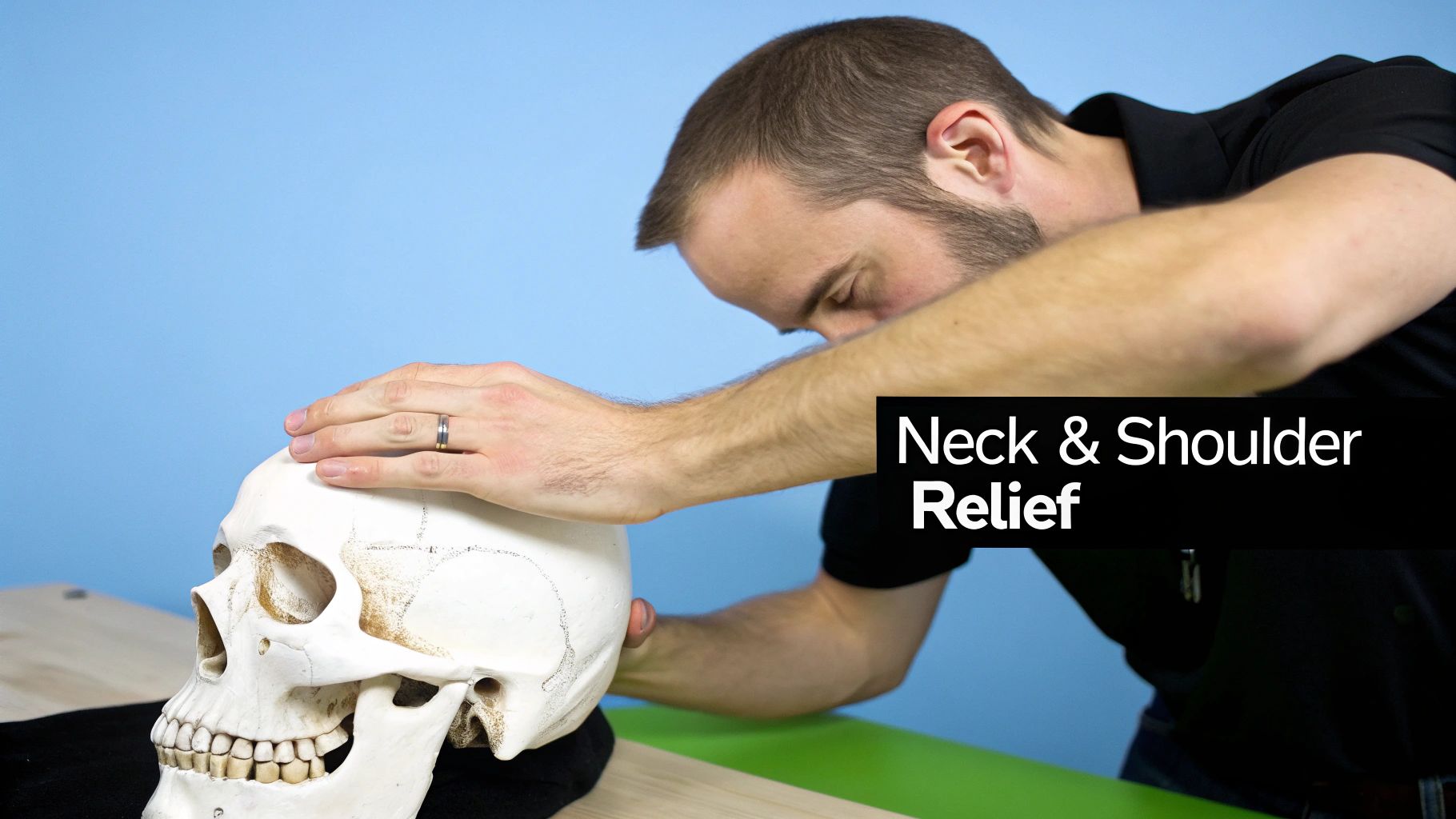
One of the most powerful pressure points for releasing this built-up tension is known as GB20, or the Gates of Consciousness. Don't let the dramatic name fool you; these are simply two spots at the base of your skull that act like a release valve for neck strain.
Finding them is easy. Clasp your hands behind your head, like you’re about to lean back and relax. Your thumbs should naturally land at the base of your skull, on either side of your spine. Feel for the two hollows where your neck muscles connect to your skull. You've found them.
Using your thumbs, apply firm pressure upwards into these indentations. You can either hold it steady for about a minute or make slow, deliberate circles. This is a brilliant technique to use discreetly at your desk when you feel tension starting to build.
Pro Tip for a Deeper Release: While pressing on the GB20 points, gently and slowly tilt your head backwards, then let it fall forward. The combination of targeted pressure and gentle movement can help break up those stubborn, deep-seated knots.
Releasing Shoulder Trigger Points
The next critical area to target is the trapezius muscle itself. A very common trigger point, sometimes called Shoulder Well or GB21, sits in that fleshy part of the muscle halfway between your neck and the edge of your shoulder.
To find it, take your right hand and feel along the top of your left shoulder. You’re searching for a spot that feels unusually tight, tender, or even like a small, hard marble under the skin when you press down. That's your target.
Once you’ve located it, use your fingers to apply firm, downward pressure. Some people find a pinching motion with the thumb and fingers works even better. Hold this for 30 to 60 seconds while taking slow, deep breaths, then repeat on the other side. This is perfect for unwinding after a stressful day or a long drive.
Finding what works best for you is part of the process, as different techniques offer unique benefits for natural tension headache relief.
By using these simple, targeted methods, you can take control and address headache pain right at its source. When you regularly release the tension in your neck and shoulders, you’ll find that you can stop many headaches before they even get a chance to start.
How to Apply Pressure for Real Results
Knowing where the tension headache relief points are is just the first step. The real magic happens when you know how to apply pressure correctly. It’s this technique that turns a simple touch into something genuinely therapeutic, giving you the best shot at kicking that headache to the curb.
The goal here is firm, steady pressure—not pain. You're looking for that "good hurt" you feel during a deep-tissue massage. It’s a satisfying ache that tells you the muscle is starting to release, but it should never be sharp, stinging, or unbearable. If you're wincing, you've gone too far. Just ease off a little until the sensation feels strong but manageable.
Mastering Your Technique
So, you've found a tender spot and you're applying the right amount of pressure. Now what? The general rule of thumb is to hold that pressure for anywhere from 30 seconds to a full minute. This gives the muscle enough time to get the message and start letting go of all that built-up tension.
You can experiment with a couple of different approaches:
- Direct Pressure: This one is straightforward—just press and hold the point with steady pressure. It works brilliantly for the Third Eye point (Yintang) between your eyebrows, where that constant, calming pressure can feel incredibly grounding.
- Circular Massage: Instead of just holding, use your fingertips or thumb to make small, slow circles while maintaining pressure. This technique is fantastic for really getting into knotted muscle tissue, making it perfect for your temples (Taiyang) or the Gates of Consciousness (GB20) at the base of your skull.
If you're curious to learn more, our guide on techniques of massage dives deeper into different methods you can try at home.
Breathe Through It: This is a big one. Don't hold your breath! As you apply pressure, focus on taking slow, deep breaths. Inhale through your nose, feel your belly expand, and then exhale slowly through your mouth. This simple act of mindful breathing tells your nervous system it's time to chill out, making the acupressure even more effective.
Putting It All Together
Here in Australia, plenty of people turn to manual therapies like acupressure to deal with tension headaches. While large-scale studies are still ongoing, we know that combining physical techniques with relaxation is a powerful duo.
One significant review found that relaxation training, when paired with thermal biofeedback, led to a 50% reduction in headache activity for some people. This shows just how much our mental state influences physical pain.
By pairing focused pressure with deep, intentional breathing, you’re not just treating a symptom—you're creating a holistic routine to manage your headache from the inside out.
Boosting Your Results with Hot and Cold Therapy
So you’ve got the hang of locating and working on those key pressure points for headache relief. That's a huge step. Now, let’s talk about taking that relief to the next level by bringing temperature into the mix.
Pairing your pressure point routine with hot and cold therapy is a game-changer. It’s a simple but incredibly effective way to tackle a headache from all sides. Think of it as preparing the muscles for release and then soothing any stubborn aches that linger afterwards.
Applying a bit of heat before you start your acupressure session can make a world of difference. It's like stretching before a run; it just gets everything ready. A warm compress or heat pack on the back of your neck and across your shoulders for 10-15 minutes gets the blood flowing and coaxes those tight, angry muscles into letting go. This simple warm-up makes the pressure points much more responsive and the relief you feel far more significant.
When to Use Heat
Reach for warmth when your muscles feel stiff, tense, and ropey. It’s perfect for those moments when you feel that all-too-familiar tightness creeping up your neck and shoulders, often the first sign that a headache is on its way.
Here’s when it works best:
- Before Your Acupressure Routine: Gently warm up the trapezius muscles and the area around the base of your skull. This makes the tissue more pliable and ready for targeted pressure.
- After a Stressful Day: Been hunched over a keyboard all day? Heat can literally melt away the physical tension that so often sparks a headache.
This pre-treatment relaxation is the key. By easing that initial muscle tightness first, you're setting the stage for your pressure point work to go deeper and be far more effective.
When to Use Cold
On the flip side, cold therapy is the ideal way to wrap things up.
Once you’ve finished working on the pressure points, applying a cold pack or a specialised Headache Cap to your forehead, temples, or the back of your neck is pure bliss. The cold helps to numb the area, dial down inflammation, and constrict blood vessels, which can be brilliant for taking the edge off that throbbing headache pain.
The combination of heat to relax and cold to numb is a powerful one-two punch against headaches. First, you release the underlying muscle tension with warmth and pressure; then, you calm the remaining pain signals with a targeted cooling sensation.
This dual approach is especially handy for those really stubborn tension headaches that just don't seem to quit with pressure alone.
If you want to dive deeper into how temperature can work for you, check out our guide on using a cold compress for headache relief. By adding both hot and cold therapy to your acupressure practice, you’re building a much more versatile and powerful toolkit for managing headache pain, all without reaching for the medicine cabinet.
Knowing When It’s Time to See a Doctor
Learning to use pressure points for tension headache relief is a brilliant skill to have in your back pocket. It gives you a sense of control over your own comfort. But it’s equally important to know when a headache is signalling something more serious that needs a doctor's attention.
Most of the time, a tension headache is just that—your body’s reaction to a stressful day or tight muscles. Sometimes, though, a headache can be a red flag for a more urgent medical issue.
Don't Ignore These Headache Red Flags
Think of this as your personal safety checklist. While acupressure is fantastic for managing the familiar ache of a tension headache, it isn't a cure-all. If you notice any of the following, it’s time to stop the self-treatment and get professional medical advice right away.
Pay close attention if your headache:
- Hits you suddenly and feels explosive, often described as a "thunderclap" headache.
- Comes with other serious symptoms like a high fever, a stiff neck, confusion, or seizures.
- Steadily gets worse over a few days instead of getting better.
- Shows up after any kind of head injury, even if it seemed minor at the time.
- Is paired with weakness, numbness, or any difficulty speaking.
When it comes to your health, trust your gut. If a headache feels completely different from your usual ones, or if it's far more severe than anything you've experienced before, don't hesitate. Seeing your GP is always the safest move. They can give you a proper diagnosis and make sure you're getting the right care for the right problem.
Your Questions About Headache Pressure Points, Answered
When you first start exploring acupressure for headaches, it's natural to have a few questions. Let's walk through some of the most common ones I hear, so you can feel more confident and get the best results from your efforts.
How Quickly Will I Feel Relief?
This is the big question, isn't it? Many people feel tension start to melt away within just a few minutes of applying firm, steady pressure. If you manage to catch a headache just as it's starting, the relief can feel almost immediate.
For those really stubborn, deep-set headaches, you might need to be a bit more patient. A dedicated 5 to 10-minute session, where you methodically work through a few different points, often does the trick. Don't be discouraged if it takes a little time; like any skill, your body gets better at responding with practice.
Should the Pressure Points Feel Sore When I Press Them?
Yes, a bit of tenderness is completely normal. In fact, it’s usually a good sign! That slight ache often means you’ve found a knot of muscle tension or a key trigger point that’s contributing to your headache.
Think of it as a "good hurt"—a deep, releasing ache that tells you you're in the right spot. It should never feel sharp, stabbing, or unbearable. If you hit a point that makes you wince with sharp pain, you’ve gone too far. Back off the pressure immediately until it feels strong but manageable.
Is It Possible to Overdo It?
While acupressure is incredibly safe, you can definitely overdo it on a single spot. Pressing too hard or for too long can sometimes cause bruising or make the area feel more tender the next day.
A good rule of thumb is to work on any given point for about 30 to 60 seconds at a time before moving on. Listen to what your body is telling you. If a particular spot feels too sensitive, give it a rest and circle back to it later.
Ready to add another powerful tool to your headache relief kit? The Headache Cap offers targeted hot and cold therapy that perfectly complements your pressure point routine. Experience drug-free relief and find your calm by visiting the official Headache Cap website.


